Download
Structured Thinking Software · Project management
A project plan usually becomes visible once tasks, dates and owners are assigned. By then, several of the decisions that actually determine whether it works have often already been made, sometimes without anyone testing them. This guide starts earlier, at the thinking.
Before anything gets scheduled
Structured Thinking gives the earliest stretch of a project a method: get the problem into the open, work out what it means, choose a direction, commit to it properly, and agree how you'll know it worked, before the work is turned into a detailed schedule.
What follows applies the same Five Stages used everywhere else in MindGenius, specifically to starting a project.
The five stages
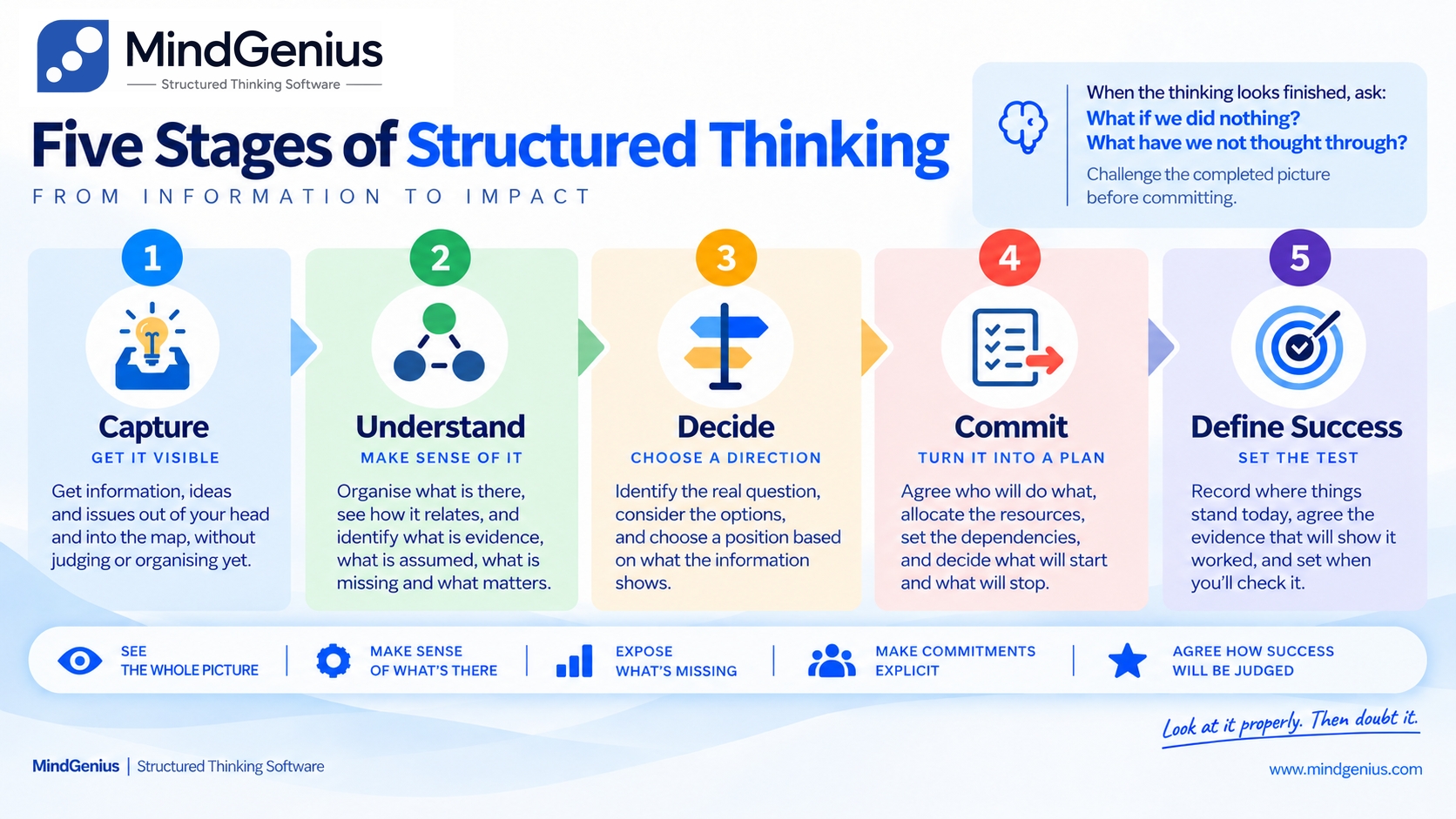
The same five stages used across MindGenius, applied specifically to starting a project. Capture through Define Success, all before execution begins.
Get the problem, the constraints, the stakeholders, the assumptions and the risks out into the open before anyone reaches for a task list. Include what you don't know as well as what you do.
This is Capture, not organisation. Get it visible first, structure comes next.
Structure the material until patterns, dependencies and contradictions become visible. Two stakeholders wanting incompatible things. A risk sitting upstream of three separate concerns. A thread everyone assumed someone else owned.
MindGenius keeps the material on one canvas as patterns, dependencies and contradictions emerge.
Compare real alternatives, not variations on the first idea that arrived. Choose a direction with the alternatives still visible, not quietly discarded on the way to an answer.
What if we did nothing? What gets worse, what stays acceptable, and what might resolve itself without intervention.
What have we not thought through? What are we assuming, what's missing, whose perspective is absent.
Two questions that reopen a decision that looks finished, asked before anyone signs up to anything.
Agree the outcome, ownership, resources, dependencies, and what stops or gets delayed to make room for it. Naming someone isn't ownership if they lack the authority to deliver.
Record where things stand today, agree the evidence that will show it worked, and set when you'll check it. The thinking isn't finished until this is answered, and a target invented after the fact isn't a test.
From decision to delivery
Once initiation and planning have produced a plan worth running, the same map carries it through execution, on the same canvas, not re-keyed into a second tool.
Turn the agreed plan into tasks with owners, not a to-do list with names attached afterwards. Ownership was already agreed in Commit, this is where it gets scheduled.
Sequence the work and set dependencies on the same map you planned on, or export to MS Project if that's where delivery needs to live.
Track actual progress against the baseline agreed in Define Success. Change requests get evaluated against the outcome that was agreed, not just against the schedule.
Close the project formally and release resources. Capture what actually happened, it feeds the next Capture rather than getting lost.
Project Charter for the commitment, Project Kick-Off Meeting for surfacing disagreement while it's still cheap, frameworks for the front end. Project Nerve Centre carries the thinking once the work is running.
Browse the frameworksCurrent practice
MindGenius doesn't require a particular methodology. Here's how the Five Stages sit alongside current project-management practice.
The Project Management Institute's PMBOK Guide is a global standard for project management. The current edition, the eighth, published November 2025, organises the discipline around six core principles and seven performance domains, with process guidance reintroduced as five non-prescriptive Focus Areas rather than a fixed sequence of phases.
The Five Stages are not a substitute for these domains. They structure the thinking that happens before and around delivery, the PMBOK domains provide a broader project-management lens for governance, scope, schedule, finance, stakeholders, resources and risk. Use the level of formality the project needs.
How decisions get made, tracked and closed out.
What's in the project, and what deliberately isn't.
Sequencing and timing the work.
Budget, cost, and the value being delivered for it.
Everyone with a stake in the outcome, and how they're engaged.
The people, tools and materials the work depends on.
What could go wrong, and the plan for if it does.
Where to go next
The Five Stages get the thinking right before the work is turned into a detailed schedule. MindGenius carries that same map through delivery, so nothing gets re-keyed into a second tool. Try it free for 14 days and run your next project on a map.
Free 14 day trial. Works offline. No card required.
Windows desktop is MindGenius 20. Working on a Mac? MindGenius Online, nothing to install →