Should we move to a four-day week?
Almost everyone has an opinion on the four-day week, which is exactly why it is dangerous to decide. It is easy to want, easy to picture, and easy to say yes to before anyone has said out loud what it would actually cost. The naive version of this decision is a feeling that it would be good for us. The real version is a set of assumptions about productivity, fairness, coverage and customer service that nobody has tested yet.
A four-day week is not a policy you adopt. It is a decision you make well or badly, and the difference is whether you surfaced what you were assuming before you committed.
What this framework explores
Assumptions
- What you are quietly taking for granted about productivity, fairness and how the work fits into fewer days
Risks
- What could stop it working, said honestly before you commit rather than discovered after
Stakeholders
- Who is affected, and how. Employees, customers, the teams who carry the change
Blind spots
- What you have not thought about yet. The coverage, the contracts, the exit plan if it does not work
Success
- How you would know it worked, held to last because you cannot measure success until you understand what it depends on
Download the framework. Keep your thinking.
Run this session in MindGenius Desktop and the map is a file on your own computer or network: the real assumptions, the honest risks, the numbers you would rather not say out loud. It goes nowhere unless you share it, or choose to ask the AI for help with part of it. For a decision this sensitive, that matters.
Why this framework works
Most discussions about a four-day week jump straight to whether it is a good idea. This framework deliberately does not. It starts by surfacing what you are assuming, exploring what could go wrong, and understanding who is affected, before it asks how success will be measured. The order is the point. You cannot measure success until you understand what success depends on, so the question everyone reaches for first is the one the framework holds until last. That is the difference between a structured way to think and a checklist you fill in.
See the framework in action
Here is the question worked through in MindGenius, the way a real session leaves it. Read it as an example of what structured thinking surfaces, not as the answer. The answer has to be yours, because your assumptions are not these ones.
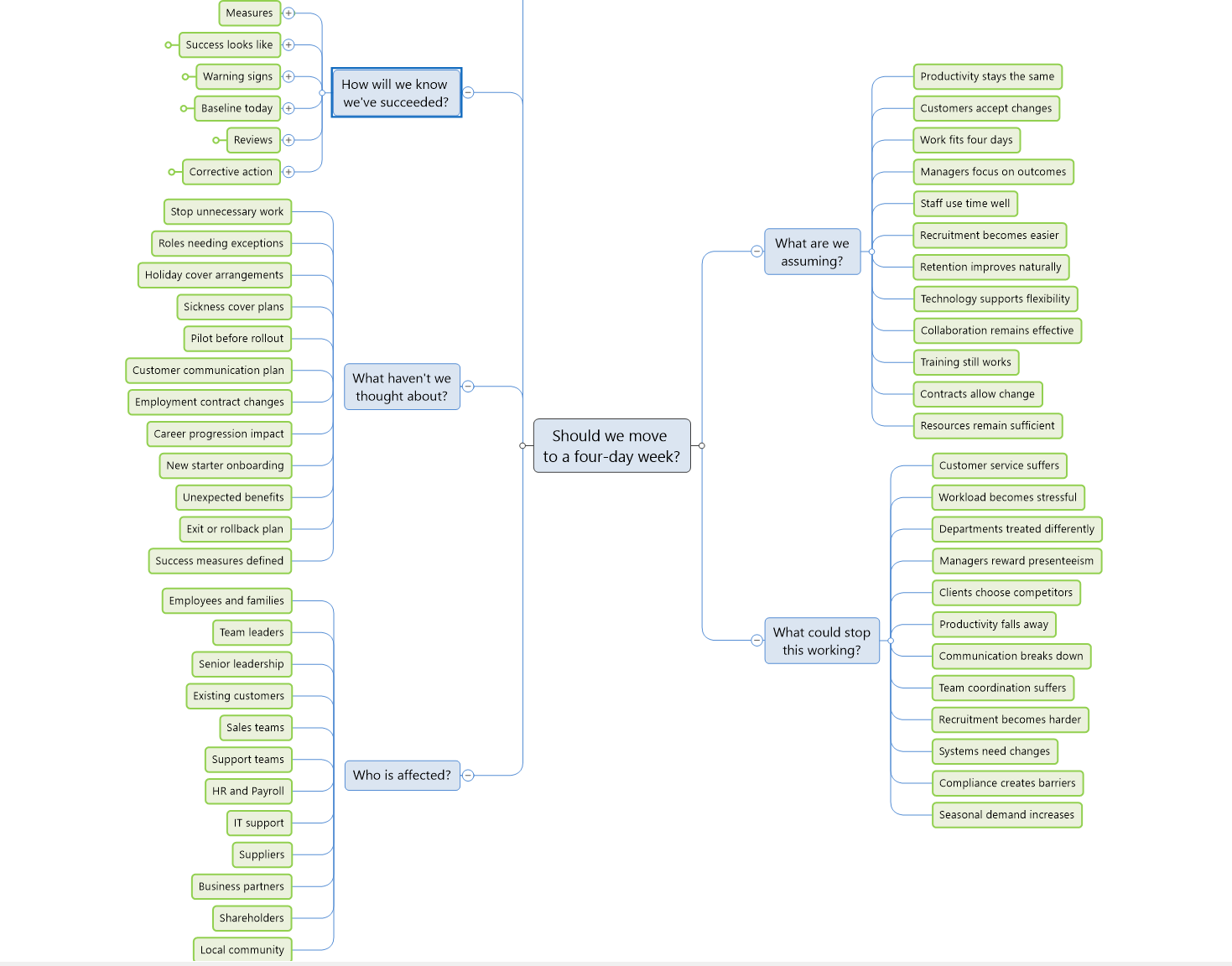
This is the running order for this session; you can come back to any of the five stages as you learn more.
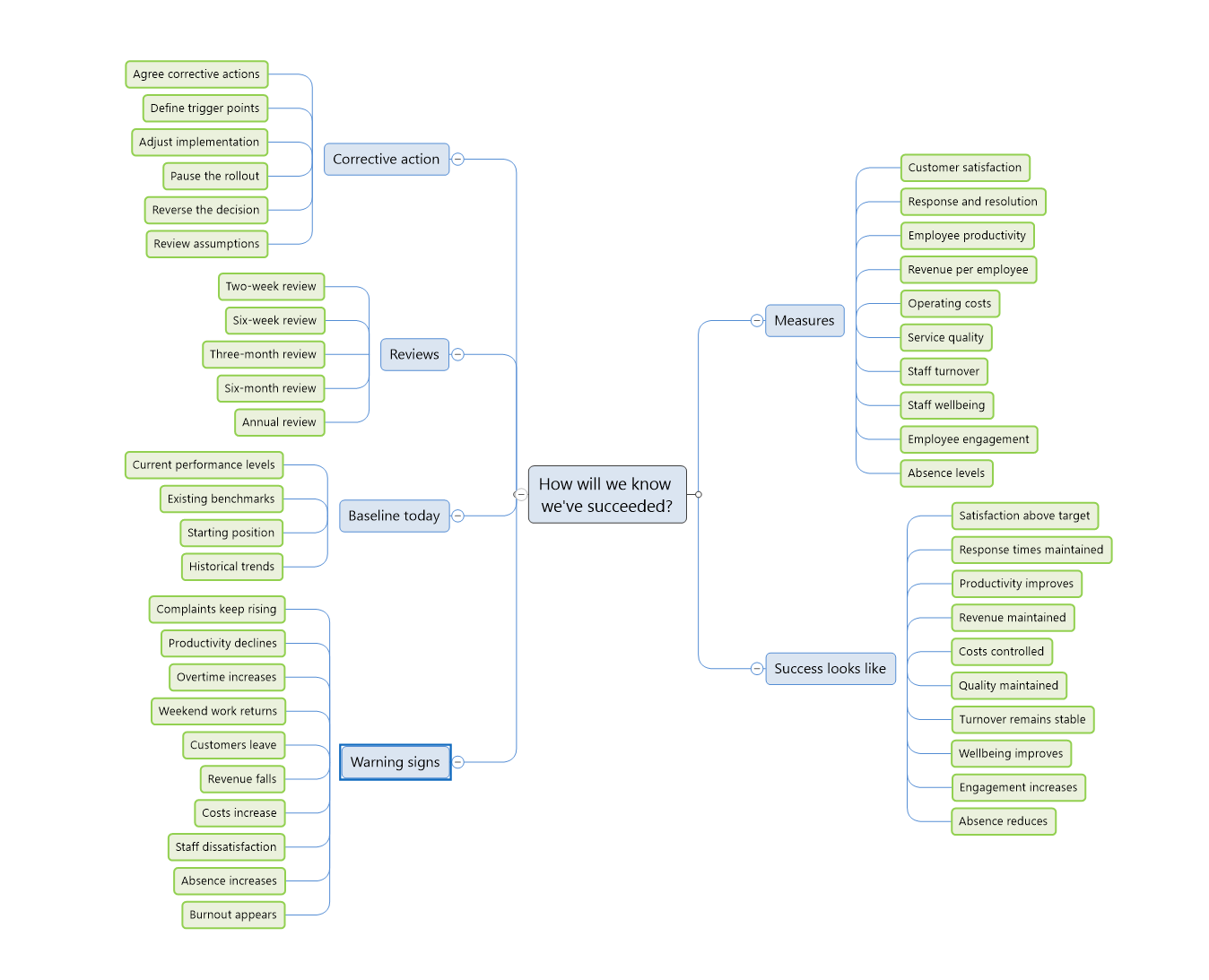
What you download is the framework, not these answers
The map above is a worked example, so you can see what a good session produces. The file you download is the same five questions as an open framework, ready for your own session. You open it in MindGenius, the questions become your capture areas, and you fill them with what your organisation is actually assuming, risking and starting from.