
Discover the dissertation before you design it.
A dissertation can stall long before the writing starts, at the point where a student has a subject, a supervisor and a deadline, but not yet a question worth a year of their life. This page follows one worked example through that earlier problem, on a single map.
Structure the thinking before structuring the document.
The two jobs a dissertation asks of you
A dissertation asks two different things, and they get confused with each other constantly. The first is to work out what the research question should be. The second is to write it up well.
A word processor is built for the second job. Started on the first, it asks you to commit to an order and a direction before you have earned either. Working out what deserves to become the research question is thinking work, not writing work. It needs somewhere to happen.
Useful before the question settles
Outlining tools, reference managers and writing assistants become most useful once a research direction is already forming. They organise, cite and draft against a question you have. The example below shows MindGenius being used earlier than that, to work out which of several possible questions deserves to become the one. This work overlaps with reading and reference gathering rather than replacing it. What it adds is somewhere to hold several possible questions side by side, and to keep the reasons for backing one of them visible.
One map, one session, captured as it grew
What follows is one map at successive points in a single working session, captured as it grew. The frames are selective rather than exhaustive. Screenshots 1 to 9 are the original session in the order they were taken. Screenshots 10 to 12 were captured later, when the Define Success branch was added, and are numbered after 9 so that the later work stays visibly later. Click any map to open it full size.
Demonstration example
This map was built to show the method. It is not a student's dissertation: no student, institution or supervisor sits behind it, and nothing on it has been agreed with one.
The example passes through five stages
- CaptureSteps 1 and 2
- UnderstandSteps 3 to 6
- DecideStep 7
- CommitSteps 8 and 9
- Define SuccessSteps 10 to 12
The stage is named against each step below. The last stage is what stops this example ending at a question having been found.
Capture
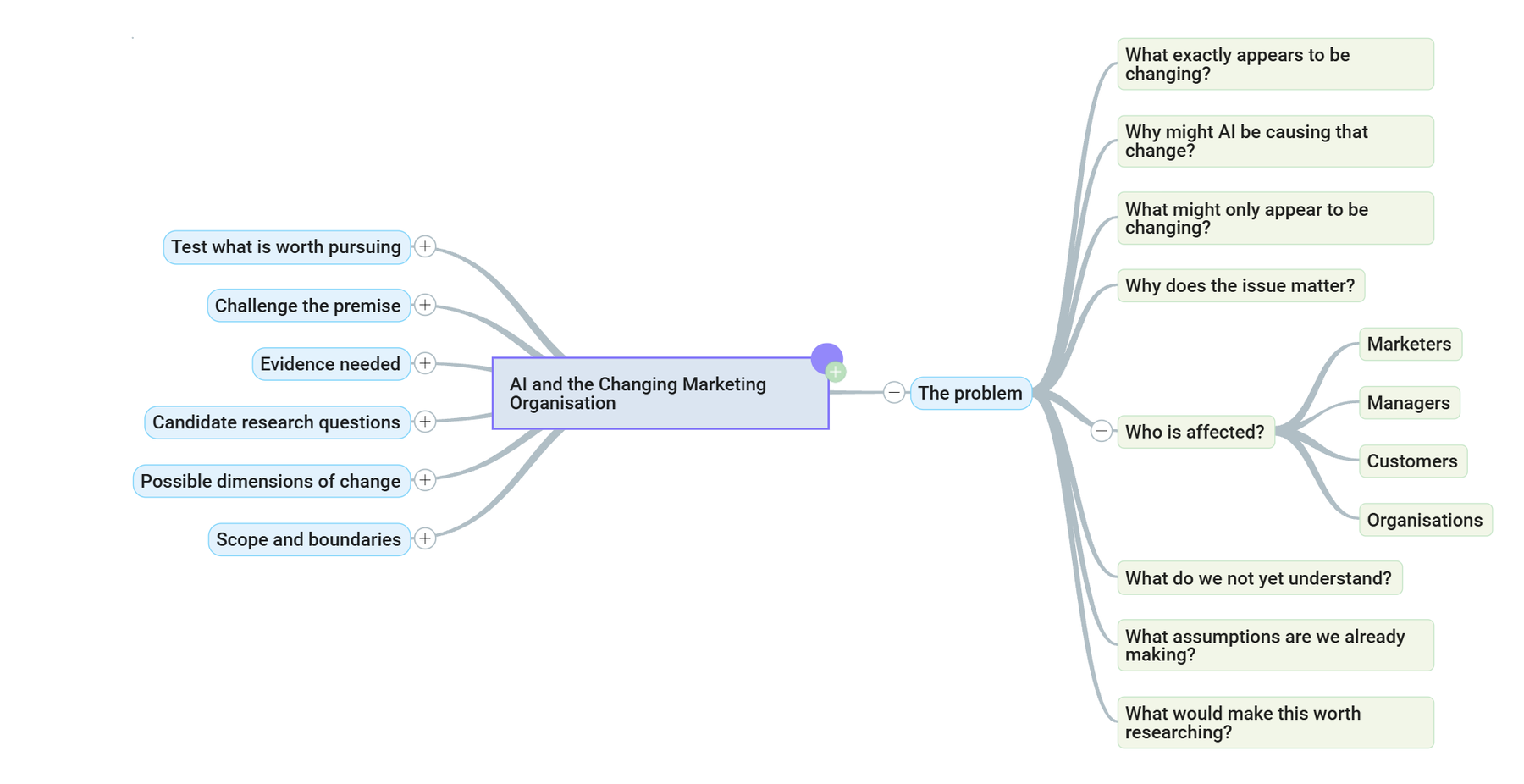
Stage one of fiveStart with the problem
Not the title, and not the topic. The first branch opens the problem up and puts questions to it: what is unclear, what is contested, and for whom. Interrogating a problem is what stops a topic being mistaken for one.
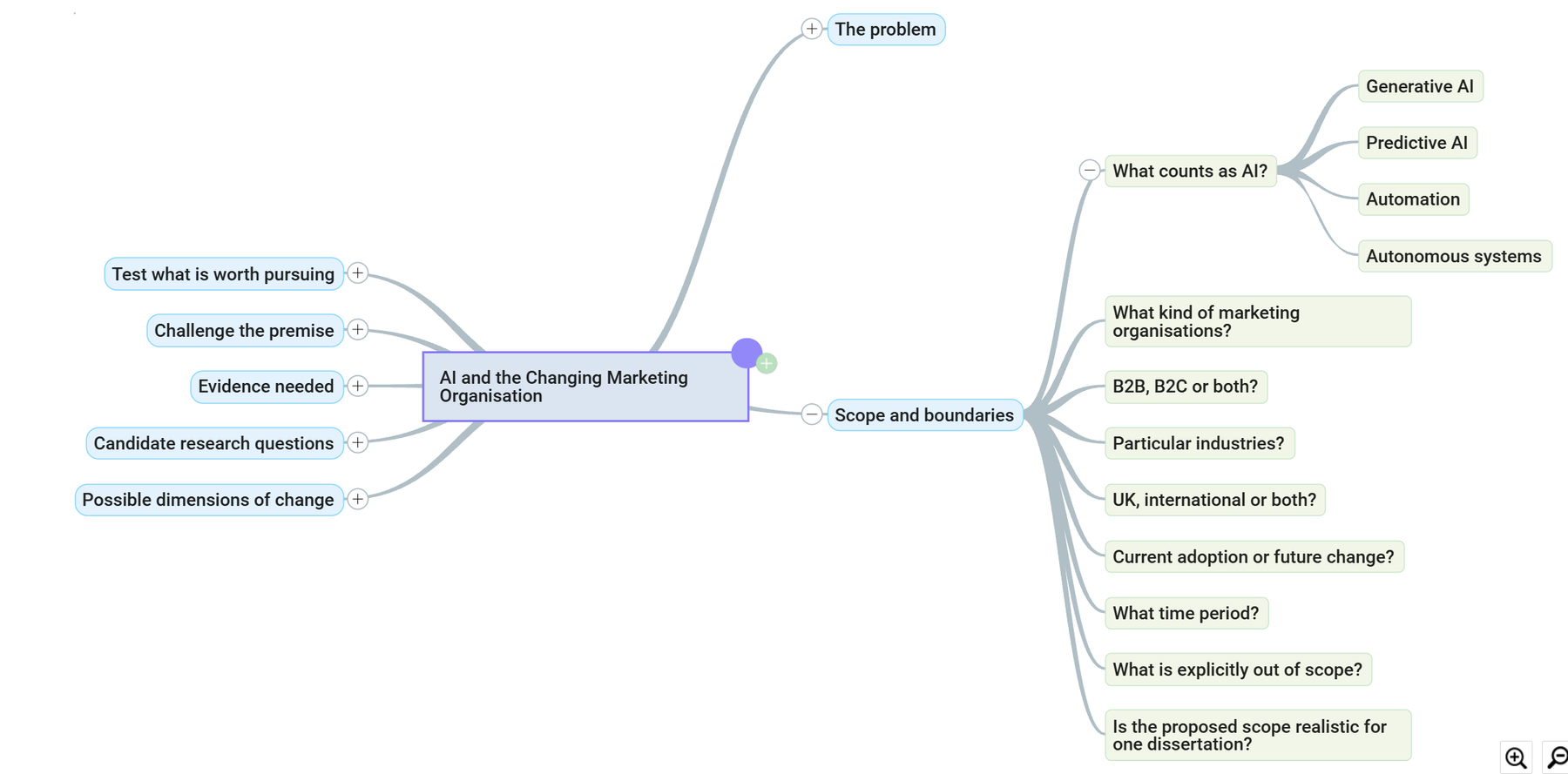
Put boundaries around it
Every problem worth studying is bigger than one dissertation. Writing down what is inside the study and what is deliberately outside it turns an unmanageable subject into a manageable one, and does it on the page rather than in the student's head at three in the morning.
Understand
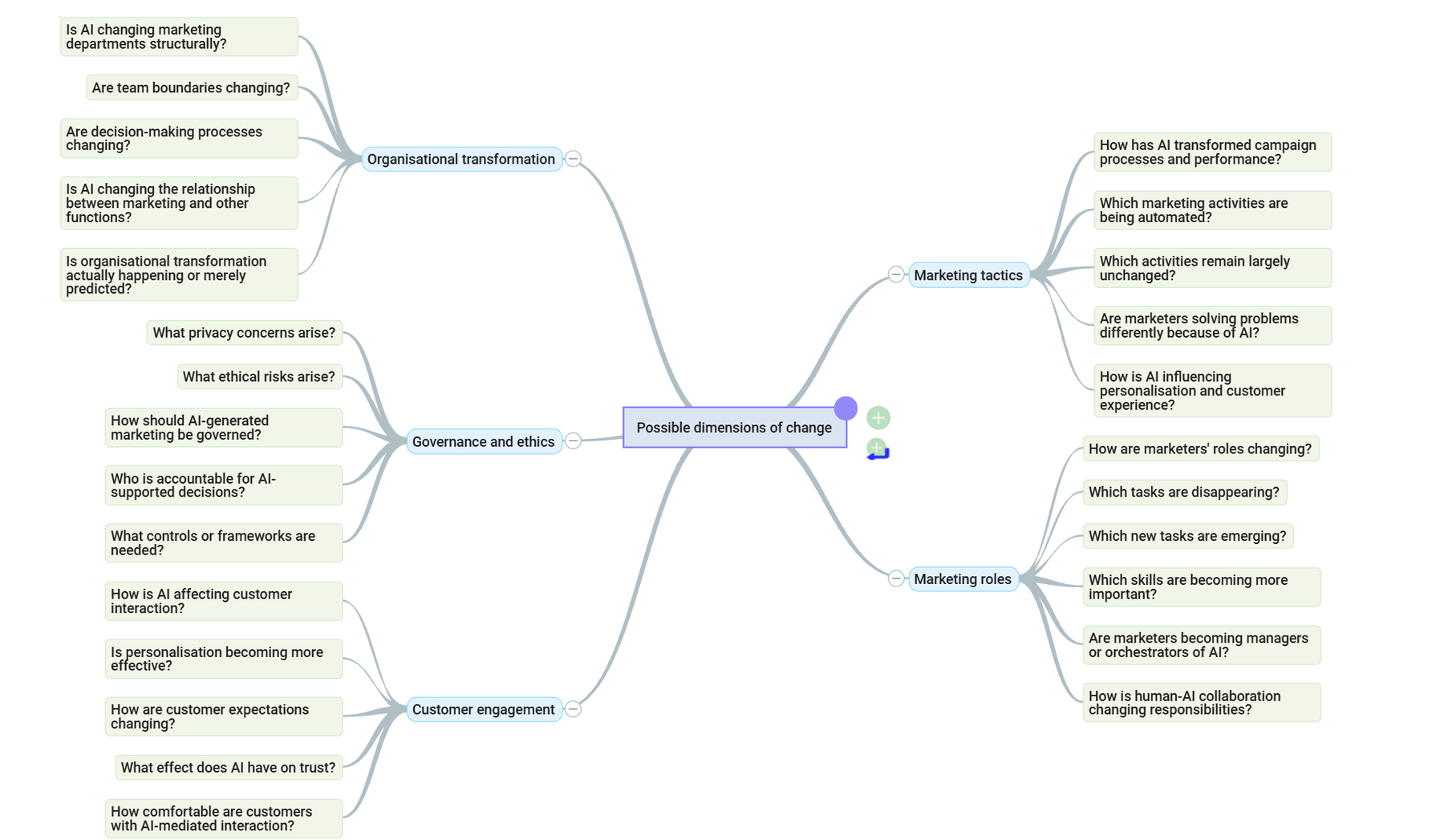
Stage two of fiveExplore before choosing
Lay out the directions that exist before backing one of them. Several branches, none of them yet the answer.
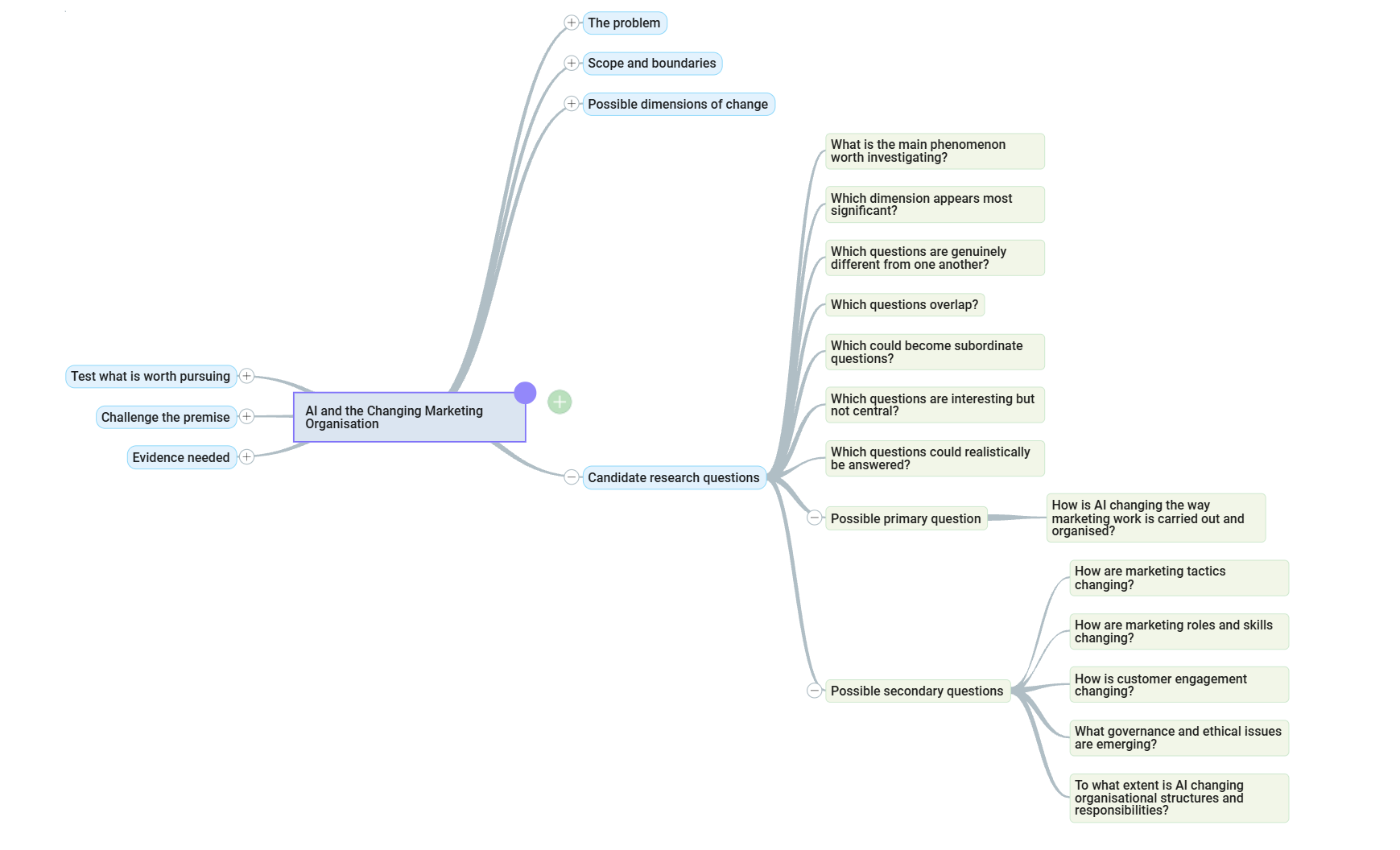
Turn exploration into questions
Now the directions become candidate research questions, several of them, sitting side by side where they can be compared. This is the first point at which the dissertation has a shape, and it arrives after the exploration rather than before it.
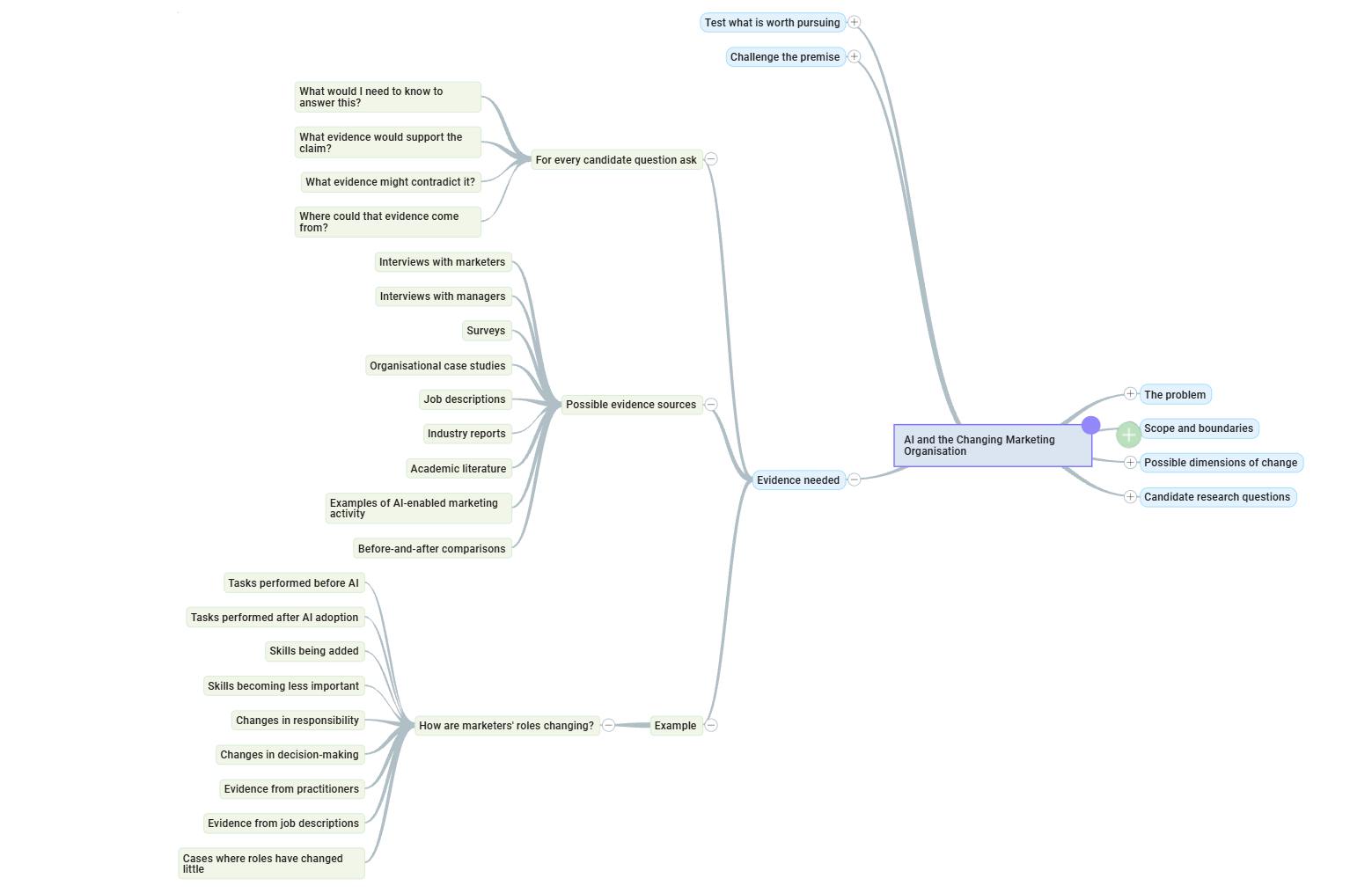
Demand evidence
Against each candidate, what evidence would you actually need, and could you realistically get it. Questions that cannot be evidenced within the time and access available are better found here than in month seven.
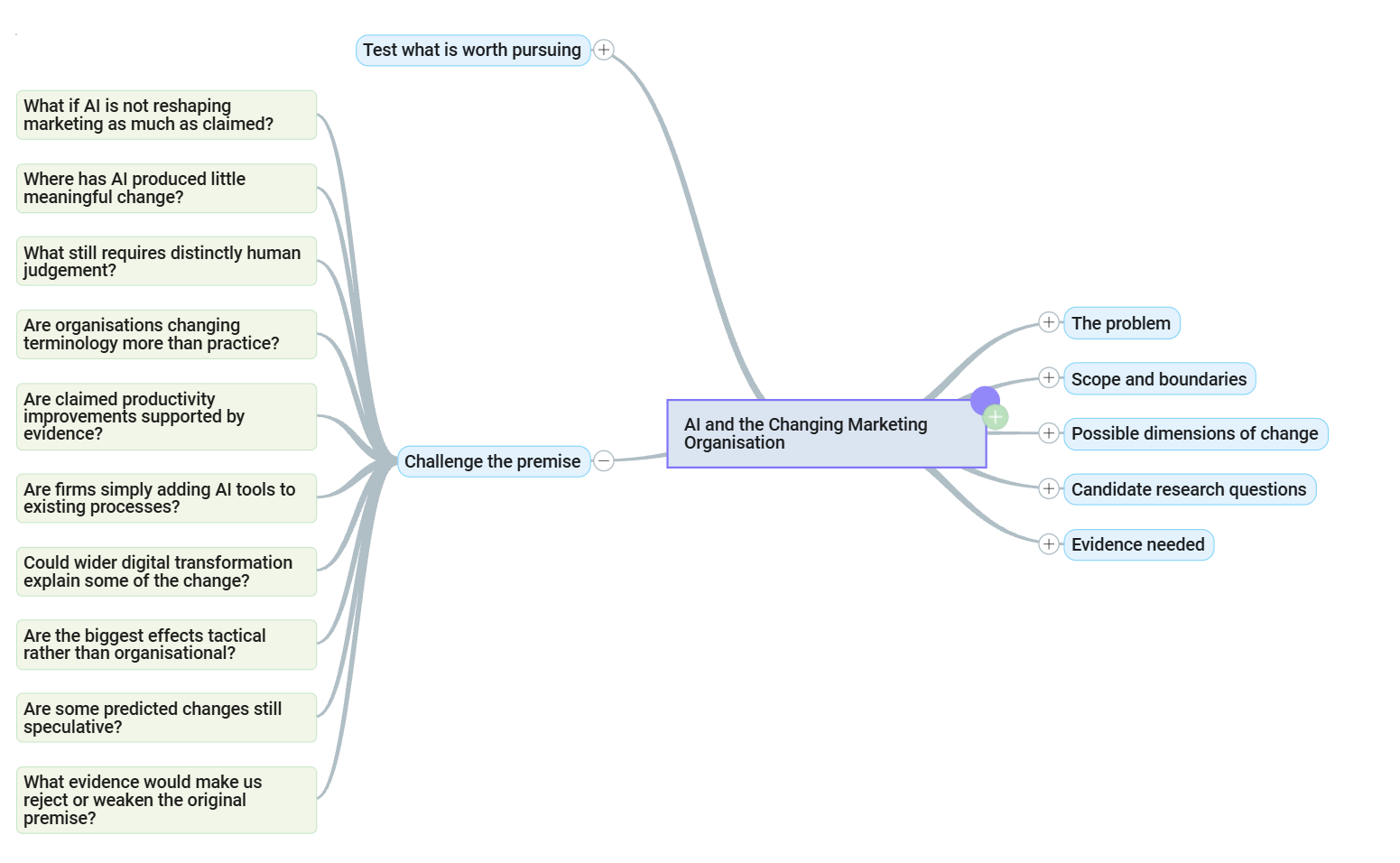
Challenge the emerging story
The premise underneath the question gets challenged rather than assumed. In this example that means putting pressure on the claim that AI is transforming the field, and going looking for evidence that points the other way. A question resting on an unexamined premise inherits its weakness.
Decide
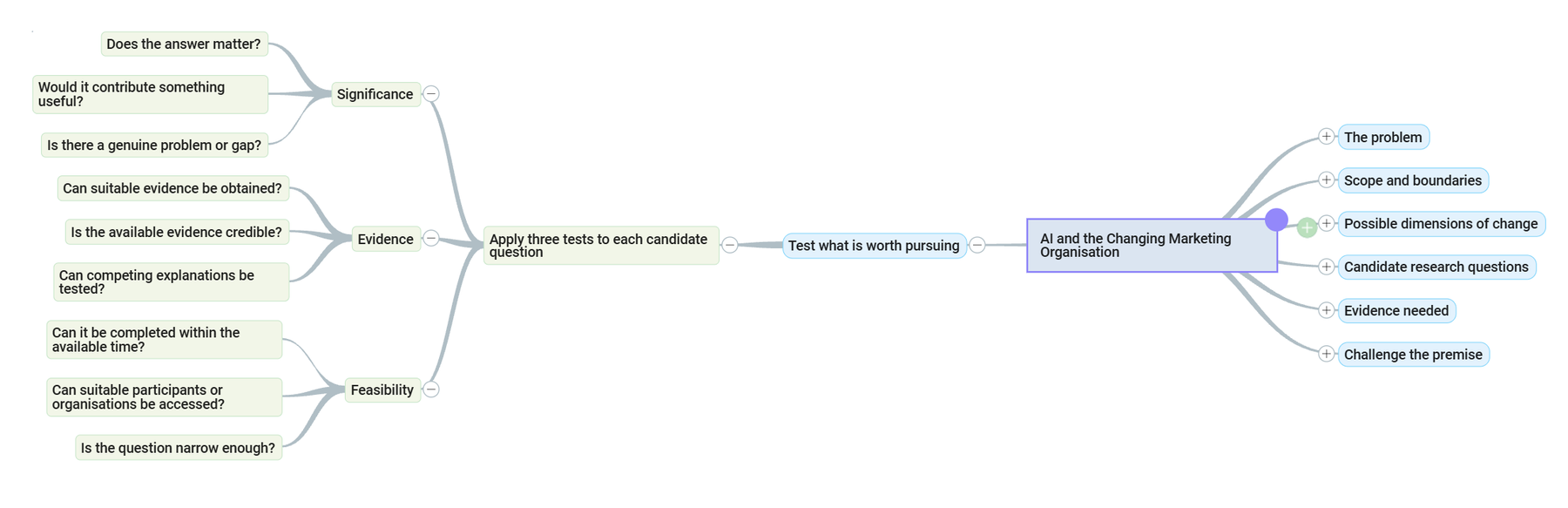
Stage three of fiveTest what is worth pursuing
This branch sets out what would make a direction worth pursuing at all. It records the tests rather than the verdict, which is the useful order. Agreeing what makes a question worth a year is easier before you have a favourite.
Commit
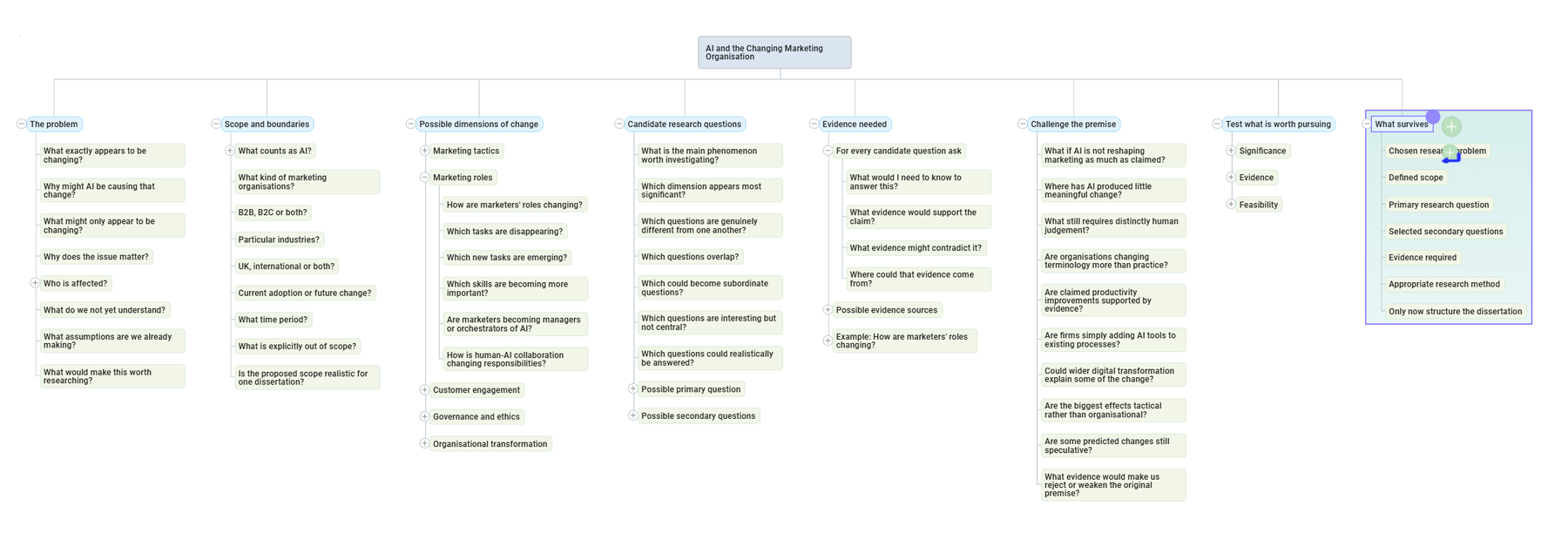
Stage four of fiveKeep what survives
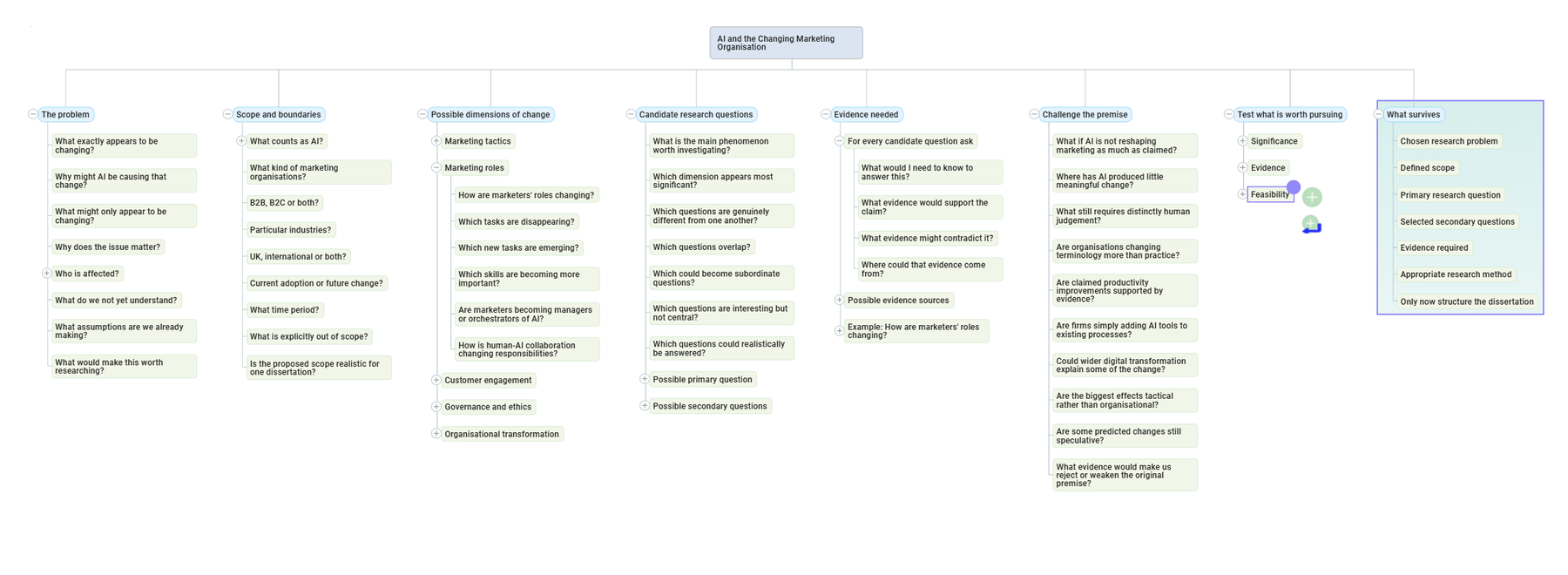
The last branch asks what comes through the process intact. The frame shows the whole journey still on screen with that branch highlighted inside it, which is the part a document cannot do. The exploration and the challenges put to it stay visible next to the outcome, so a supervisor asking what else was considered has something to look at.
Where the session finished
Eight branches, one map, and the thinking that produced the question still sitting beside it.
Define Success
Stage five of fiveWhat the thinking arrived at
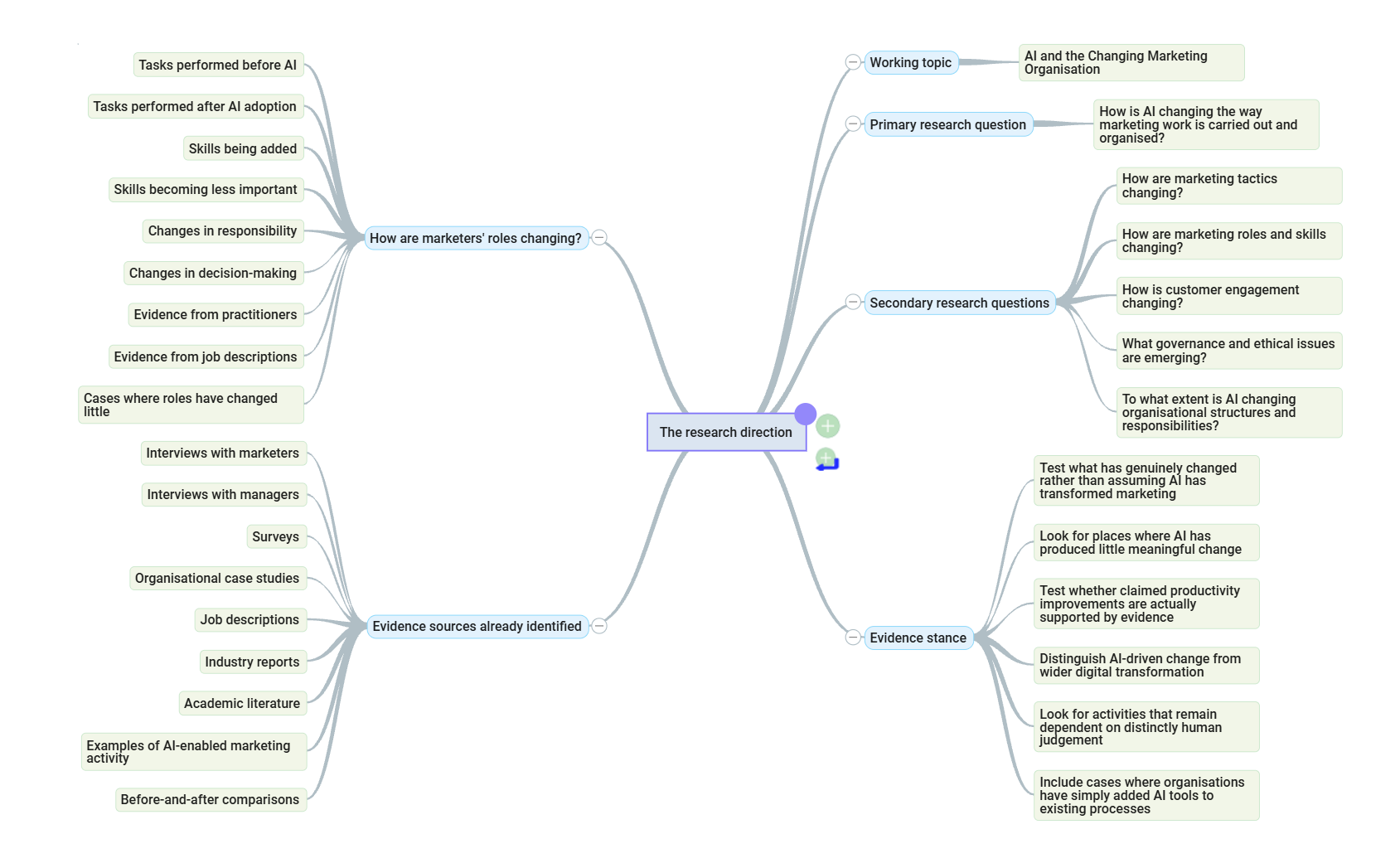
The criteria have to judge something. This is the direction the session produced: a working topic, a primary question, the secondary questions under it, a stance on evidence and the sources already identified.
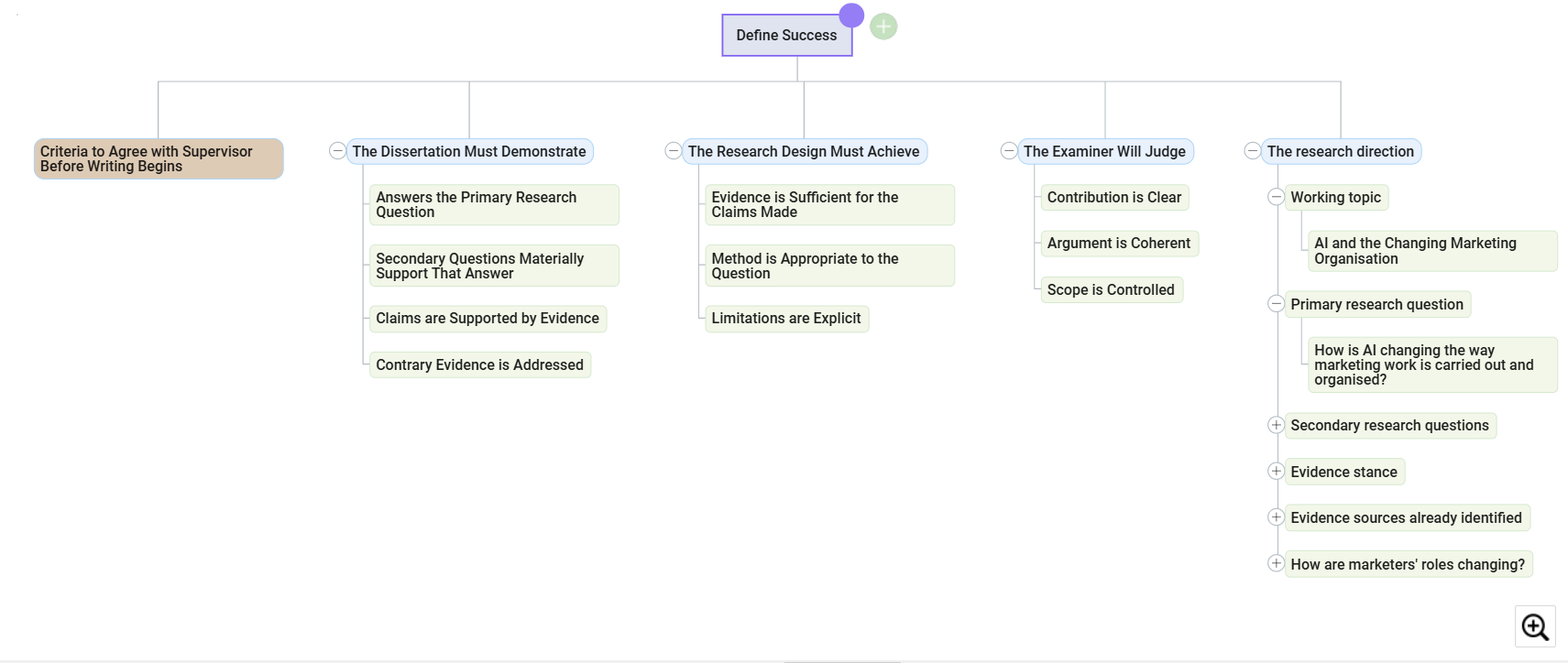
Set out what a good dissertation must demonstrate, before you write a word
Before writing begins, set out what the dissertation will need to demonstrate, what the research design must achieve and what it will ultimately be judged against. Then take those criteria to the supervisor for agreement. Written down in advance, the criteria decide whether the work has landed. Left until after the work, they stop being a measure and become a justification of whatever happened.
The complete journey
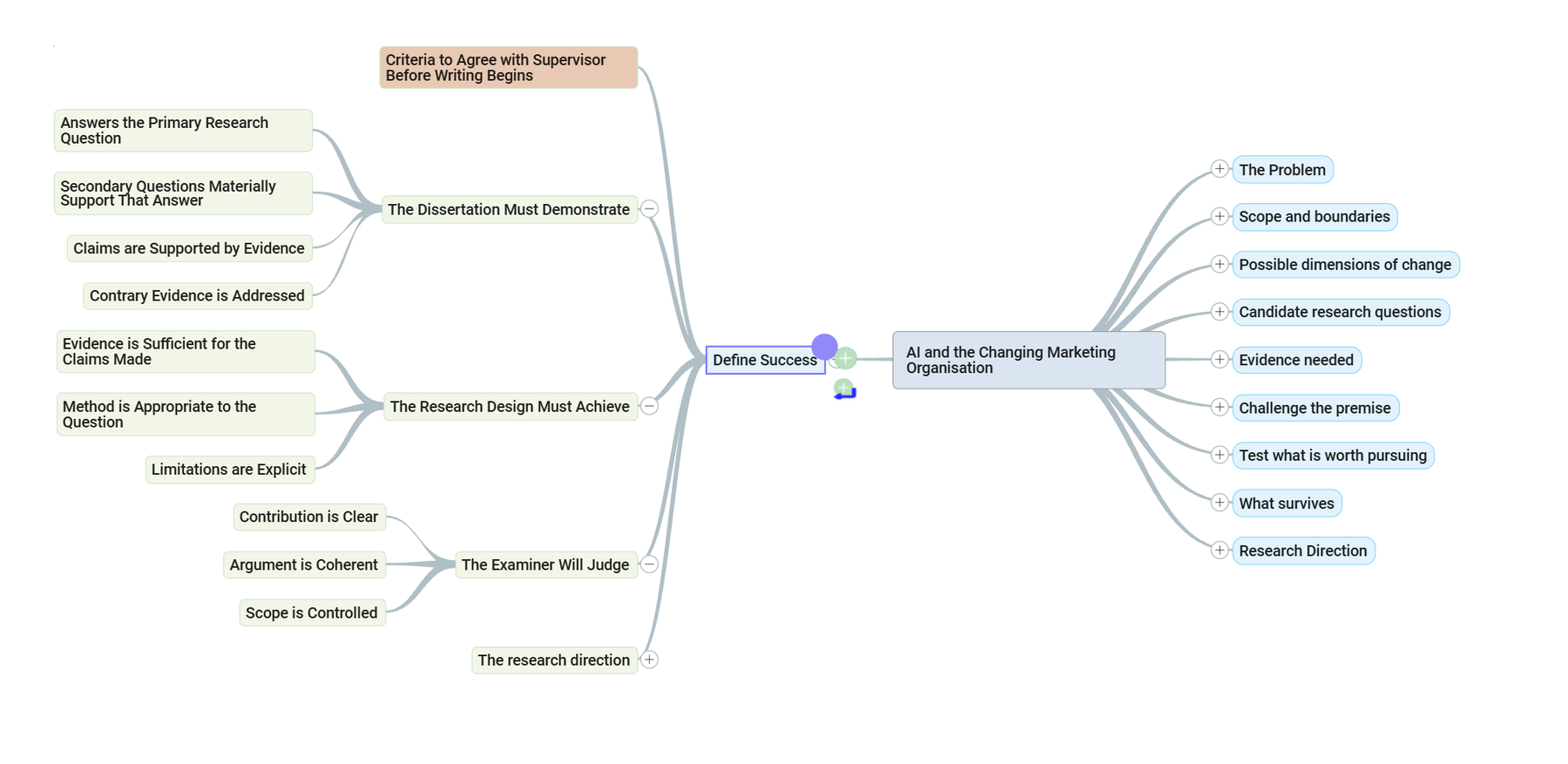
StageAll five stages, one map
The eight branches from the original session, the research direction and Define Success, together. This is the view that shows the whole method rather than part of it, and the only one that proves the later work was added to the same map rather than done on a new one.
That is the last child of What survives on the map, and it is the point this worked example hands over. Once the question is settled and the standard is set, the dissertation itself needs a structure to hold the argument.
Students who used MindGenius and said so
Gemma Campbell passed first year with distinction at a 73% average across a chemistry degree that also spanned maths, biology and physics. Dr Brooke Marron used it for lecture notes, exam study, research, her dissertation and group work.
Approved assistive technology, useful to everyone
MindGenius is approved by the British Dyslexia Association and supported under Disabled Students' Allowance. The same visual approach helps every student, not only those who qualify for funding.