
The Structured Thinking Handbook: Multi-perspective
thinking
Look at it properly. Then doubt it.
Look at one decision from deliberately different positions, with a rule beside each saying what good thinking looks like there and what to distrust. Then challenge the whole picture before anyone commits to it.
The perspectives help you look. The rest of this handbook shows you how to use them well: where the work sits in its life, what stops you fooling yourself along the way, and what none of it can prove.
How the pieces fit together
Three different dimensions, not three steps. The perspectives are how you look, and you can use them at any stage. The five stages are when the thinking is. The rules run through all of it, and reading the shape sits alongside. Everything after this is these pieces in detail.
The stages are not a one-way sequence. You will move backwards as often as forwards, and Define Success can send the thinking all the way back to Capture.
And the perspectives are not a stage. Understand is where they usually earn their keep, which is why it is marked, but nothing stops you changing perspective at Capture or at Commit.
What this is for
Before the method, the problem it exists to deal with. It is not that people think badly. It is that attention has momentum.
Good people miss obvious things because they are busy thinking hard about everything already in front of them.
You can challenge what you can see. Give someone a plan and they will find the weakness in it. Give them five options and they will compare them properly. Give them a risk register and they will argue about the risks all afternoon.
The difficulty comes one step earlier. What should have been on the page and is not?
The missing stakeholder does not complain. The assumption nobody noticed does not label itself. The alternative nobody generated cannot lose the comparison. The dependency nobody thought of does not turn red on the plan.
Nothing has gone wrong when this happens. Nobody has been careless, nobody has been silenced, and nobody failed to prepare. The group has become very good at thinking about the thing it is already thinking about, which is what a group is supposed to do.
It is also why important omissions are so often obvious in hindsight. They were never difficult to understand. Nobody was looking in their direction. That is why, when somebody finally says the missing thing, the reaction is not admiration. It is: of course, how did we not think of that?
Structured Thinking is partly the discipline of making yourself look somewhere else before you move on.
What it actually does
It gets more of the thinking out where it can be examined, gives it enough structure that gaps, relationships, contradictions and alternatives become easier to see, and creates moments where the momentum is deliberately interrupted.
Two of those three are about the content. The third is about attention, and it is the one people skip.
It also gives you a second way out of the pull of the content. Instead of asking what a branch says, you can stand back and ask why that branch is so small, why everything has clustered over there, why there is only one option, why this subject keeps reappearing. Attention shifts from the content of the thinking to its shape. That is what chapter five is about.
Structure is not free. It takes effort, it can be overdone, and a map built to look thorough is worse than a rough one that gets used. Chapter three exists to keep that in check.
And one move that has to arrive from outside the work
When the thinking looks finished, that is the point at which nobody is looking for what is missing. Two questions asked there can do something that further effort inside the existing picture easily misses. They belong to the method rather than to this introduction, and chapter one sets them out.
AI helps you think. You decide.
For how this works in practice with AI tools, including MindGenius AI, see Get more from AI with Structured Thinking.
Multi-perspective thinking, which follows, is a practical way of doing all this deliberately rather than hoping it happens.
Multi-perspective thinking
One decision, looked at from deliberately different positions. This is the part you can pick up and use today. Everything after it is how to use it without doing it badly.
The introduction described the problem: attention stays where it already is, and what is missing does not announce itself. If that is the problem, then the answer is not to think harder about what is in front of you. It is to move deliberately to somewhere else and look from there.
That is rule two made practical. No single view is the whole picture. Multi-perspective thinking gives that principle somewhere to live, and the set below is the one that does it.
The decision
What are we actually deciding?
Watch forAnswering the question you were handed.
Questions to ask
- What decision are we really trying to make?
- What is in scope, and what is not?
- What would have to be true for us to be confident enough to act?
Answers to expect
- A clear decision question, stated plainly
- The assumptions the decision rests on
- What is in scope and what is not
- What would change the answer
Watch out for
- Treating it as a summary of what everyone else said
- Answering the question you were handed instead of asking whether it is the right one
The evidence
What do we know, and what do we not?
Watch forFilling a gap plausibly instead of recording it as a gap.
Questions to ask
- What do we know?
- What do we not know?
- What evidence do we have?
- What would we need to find out?
Answers to expect
- Facts, figures and evidence
- Known constraints
- Gaps in information
- Assumptions that need checking
Watch out for
- Opinions presented as facts
- Numbers with no source
- Filling a gap with something plausible instead of recording that it is a gap
The risks
What could go wrong?
Watch forStopping at the risk.
Questions to ask
- What could go wrong?
- Why might this fail?
- What could hurt us?
- What assumptions are dangerous?
Answers to expect
- Risks and weaknesses
- Unintended consequences
- Failure points
- Legal or operational problems
Watch out for
- Becoming automatically negative
- Stopping at the risk. Every risk should lead to how we would prevent or control it
The value
What could go right?
Watch forWishful benefits, with no way of telling whether they arrive.
Questions to ask
- What could go right?
- Why is this worth doing?
- Who benefits?
- What opportunity does it create?
Answers to expect
- Benefits and advantages
- Savings and improvements
- Strategic opportunities
- Positive consequences
Watch out for
- Wishful thinking
- Benefits with no reason behind them and no way of measuring whether they arrive
The alternatives
What else could we do?
Watch forVariations of the same answer.
Questions to ask
- What else could we do?
- Is there another way?
- Can we change the idea?
- What other way could solve the underlying problem?
Answers to expect
- Genuine alternatives, not variations
- New approaches
- Combinations and workarounds
- Experiments worth running
Watch out for
- Only producing better ways to make the original idea work
- Failing to ask whether there is a different solution to the underlying problem
The people
What might others see that we do not?
Watch forInventing their views and presenting it as finding out.
Questions to ask
- Who is affected by this?
- Who sees it differently?
- Whose judgement or reaction actually matters?
- What do we know about their view, and what are we assuming?
- What would we need to ask rather than assume?
Answers to expect
- Named people and groups, not categories
- Views we actually know, and how we know them
- Conflicting interests, stated plainly
- Likely reactions, clearly labelled as our guess rather than their view
Watch out for
- Inventing what people feel and presenting it as finding out
- Treating a stereotype about a group as evidence about a person
- Not asking, when asking would be cheap
The method is the behaviour, not the count
Multi-perspective thinking is the method. These six are the useful set. A perspective earns its place by producing something the others do not, and it is worth checking that it still does.
One of them changed on that test. An earlier version asked how the decision felt, which produced plausible emotions nobody had checked. It became the people, which asks who is affected and what we actually know about their view.
Two things make these more than six headings
While you work, two rules hold in every perspective. If the information is insufficient, say so rather than filling the branch because it exists. And do not introduce a fact, number, threshold or timescale unless it was supplied, derived in the open, explicitly proposed as a choice, or marked as needing verification. Both appear again as rules seven and eight, because they apply everywhere, not only here.
When it looks finished, ask the two head scratchers below. They work by arriving when you think you are done.
Look at it properly. Then doubt it.
And two questions when it looks finished
The perspectives build the picture. These two challenge it. Ask them when the work appears complete and before anyone commits, because that is exactly when nobody is searching for what is absent.
What gets worse, what stays acceptable, and what might resolve itself without intervention? Every option gets compared against acting. The do-nothing option is easily left out.
What are we assuming? What is missing? Whose perspective is absent? What consequence have we not followed far enough?
Everyone deliberately looks in the same direction at the same time, so nobody is defending a position while somebody else searches. For a few minutes the job is not to improve the answer, resolve the issue, add detail or decide anything. The job is only to look away from whatever has occupied the room and ask what else should have been in this conversation.
Ask, capture, keep looking, and discuss afterwards. If you stop to debate the first thing that surfaces, it simply becomes the next thing everyone is absorbed by, and the search ends there.
Chapter two gives them a fixed place in the flow of work, between Decide and Commit. Neither will always produce something, and silence is not a failure of the technique. Its value is in the occasions when something surfaces that would otherwise have been discovered much later and much more expensively.
These two questions can reopen the thinking. They do not verify what has already been written. Neither will correct a figure already on the page, because by then it has stopped looking like a claim and started looking like the background everyone is reasoning from. Where the decision depends on something being true, check it separately.
The Five Stages
The Five Stages of Structured Thinking are not a one-way sequence. They are five recurring questions you return to as your understanding grows. You will move backwards as often as forwards.
Perspectives are how. Stages are when. The perspectives in chapter one help you think. The five stages show how that thinking develops, from what you first know through to an agreed definition of success.
Download the Five Stages, one-page guide →
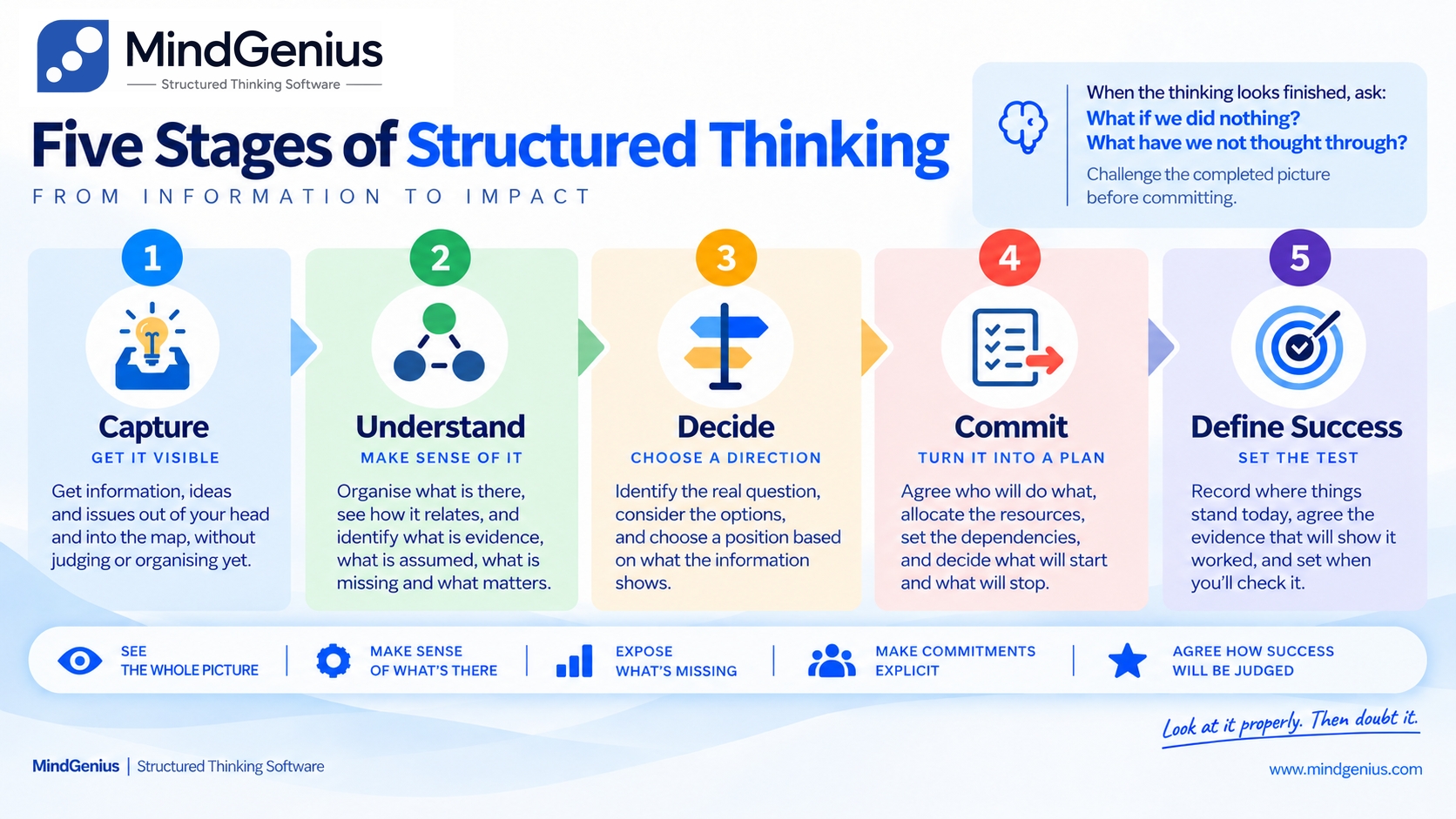
Each stage is also a place to look for what is absent
The head scratchers in chapter one are deliberately broad. They turn everyone towards absence without telling them where to look. Different things matter at different points in the work, and the stages give you somewhere more specific to search. Each stage keeps its own question, which is what the stage is for. Alongside it sits a second lens for what may be missing.
This is also why the stages recur rather than run once. Finding a missing baseline at the fifth changes what you thought you knew at the first.
The lens is an addition, not a replacement. Structured Thinking is just as much about what is already present: the relationships between things, the causes behind them, the contradictions, the tensions between two legitimate aims, the alternatives you generate rather than discover, and the trade-offs you accept. Absence is the part most often neglected, which is why it leads here.
Capture
What do we know?Get the situation into view before deciding what it means.
Look for
- Facts, observations and constraints
- Assumptions, worries and open questions
- Things people suspect but cannot prove
- What operations, finance, the frontline and the customer each see
- What has not entered the picture yet
Watch out for
- Starting downstream, with an answer already attached
- Forcing structure too early, so premature categories reproduce what you expected to find
- Hidden assumptions. An assumption is fine, an unlabelled one is not
- Leaving out what you do not know
Move on when
There is enough material to start finding out what it means. Not when every thought has been collected.
In more detail
Most work starts too far downstream. Someone arrives with an answer already attached.
"We need a new CRM."
"We need to automate this."
"We need to launch by October."
Capture moves the starting point back. Collect facts, observations, assumptions, worries, questions, constraints, and the things people suspect but cannot prove.
Include what different people see. Operations, finance, the frontline and the customer each hold a different piece of the situation.
Do not force structure too early; premature categories can reproduce what you expected to find. A flat list at this stage is deliberate, and chapter five explains how to tell a deliberate flat list from one that never moved on.
- Separate what you know from what you think. An assumption is fine. A hidden assumption is not.
- Write down what you do not know. "We don't know yet" is often the most useful branch on the map.
Understand
What does it mean?Structure the material until it shows you something.
Look for
- Groupings and patterns as related ideas come together
- Separate problems clustering around one cause
- Two sensible branches that turn out to contradict each other
- What sits upstream of the thing nearest the failure
- The gap between what the organisation says and what it does
- Themes carrying one thin line beside themes carrying three or four
Watch out for
- Hunting for one root cause. Complex outcomes usually have several acting together
- Fixing the thing nearest the failure because it is nearest
- Structure built to look thorough rather than to be used
Move on when
You can say what appears to be happening, why it matters, and which parts deserve attention.
In more detail
A flat list tells you what is there. Structure starts to show you what matters.
Group related ideas and patterns appear. Separate problems cluster around one cause. Two sensible branches turn out to contradict each other. One important topic stays thin while everything round it grows.
Then look upstream. The thing nearest the failure may not be the thing that needs fixing.
Do not hunt for one root cause. Complex outcomes usually have several causes acting together.
Also check what the organisation says against what it does. A company can say customer experience is the priority while every target, budget and decision favours something else. That gap is a finding.
Then look at where the map has not grown. A theme carrying one thin line, sitting beside themes carrying three or four, is worth another look. The comparison can make uneven attention easier to notice. Chapter five takes this further.
This is where the perspectives do most of their work. Chapter one set them out. Understand is where changing perspective usually earns its keep, because it is the point at which the material is present but its meaning is not yet settled.
Decide
What should we do?Choose with the alternatives still in front of you.
Look for
- Genuine alternatives, and the alternative nobody has considered
- Ways to improve the choice rather than pick between the options you started with
- A pilot, a change of scope, a different sequence, another way to meet the same need
- Tensions where two things both matter
Watch out for
- The first plausible answer winning because it arrived first
- Yes or no questions. Treat them with suspicion
- Forcing a tension into a choice, which creates a new problem somewhere else
Move on when
A choice has been made and you can say what it gains, what it gives up, what it assumes, and what is still uncertain.
In more detail
The first plausible answer is attractive mainly because it arrived first. Once people start discussing how to do it, it is already winning.
Put a space between "here is an answer" and "this is the answer".
Treat yes or no questions with suspicion. Could you pilot it? Change the scope? Sequence it differently? Meet the same need another way? Good decisions often come from improving the choice rather than picking between the options you started with.
Many business problems are not good against bad. They are two things that both matter.
So the question is usually not which one wins. It is how to advance one without needlessly damaging the other. A contradiction needs resolving. A tension needs managing. Forcing a tension into a choice creates a new problem somewhere else.
Two head scratchers
The decision looks finished. That is the point to distrust it. Ask both before anyone signs up to anything.
What gets worse, what stays acceptable, and what might resolve itself without intervention? Every option gets compared against acting. The do-nothing option is easily left out.
What are we assuming? What is missing? Whose perspective is absent? What consequence have we not followed far enough?
These questions can change the frame, reveal an alternative or expose something missing. They do not establish that facts, figures or assumptions already in the map are correct. Where the decision depends on something being true, check it separately. The pair, and what they are for.
Commit
What are we agreeing to?Agree the plan with the person the work is for, and put the organisation behind it.
Look for
- The same intended outcome, agreed outward and inward
- An owner given the outcome rather than the task
- Authority, resources, information and access to match the ownership
- What we are stopping, delaying or refusing to make room
- Dependencies understood and a credible timescale
- Purpose, outcome, requirement and method kept apart
Watch out for
- Naming an owner who lacks the authority, information, resources or access to deliver
- A method proposed early becoming an unquestionable requirement
- Timescales invented here rather than agreed. Rule eight applies
- Twenty top priorities, which are no priorities
Move on when
Both sides have agreed the same intended outcome, the work is owned and resourced, the necessary trade-offs have been made, and the judgement needed to deal with reality is still intact.
In more detail
Two things happen here, and both are agreements. Outward, with the person the work is for: this is what we are going to do. Inward, with the people who will do it: this is what we are going to put behind it. On Desktop this stage surfaces as Sign off.
Decide chose the answer. Commit agrees the outcome. The outward half comes first, because it is where the expensive misunderstanding surfaces if it is going to surface cheaply at all. What is agreed here is the intended result. How that result will be judged comes next, in Define Success.
The inward half means organising resources and attention around the choice. Which brings the question organisations avoid: if this really matters, what are we going to stop, delay or refuse in order to protect it? Twenty top priorities are no priorities.
Give the owner the outcome, not the task.
"Implement the CRM." prescribes a method.
"Give the sales team a reliable shared view of customer activity so opportunities stop falling between people." sets an outcome and leaves room to judge how.
Keep these four apart.
None of the four is untouchable. Reality can change a requirement, and occasionally an outcome. The point is that they were agreed before execution, so changing one is a decision somebody makes rather than a drift nobody notices.
Naming someone is not ownership if they lack the authority, information, resources or access to deliver. Before commitment is real, check:
- Is the outcome clear, and do they know why it matters?
- Do they have the authority, the resources and the information?
- Are the dependencies understood and the timescale credible?
- What can they decide themselves, and when should they ask?
- What are we stopping to make room?
- What challenges might crop up, and how might we meet them?
- What would make us reconsider?
Where the method genuinely must be followed, say so. Safety, regulation and established technical procedure are real.
Send the owner the surrounding thinking, not an isolated task. The map then becomes the work: owners, status and progress in one place, without re-keying any of it into a second tool.
Define Success
How will we know?The thinking is not finished until you have said how you will know it worked.
Look for
- Compared with what? What is true today
- What will be different? The intended result, plainly enough that both sides would recognise it
- How will we know? The evidence, measured or observed, and the same thing as the baseline
- When do we look? The point at which the evidence is read, and who reads it
Watch out for
- Nobody able to say what is true today. That is not an inconvenience, it is a finding
- A baseline and a result stated as unlike measures
- An invented percentage attached to a vague benefit
- Measures that describe activity rather than whether the situation improved
- An agreed test nobody has diarised
Move on when
The before position, the intended change and the evidence are agreed and written down, and the person the work is for has said yes to them.
In more detail
This stage does not reopen what you are aiming at. Commit settled that. What is still missing is the before position and the evidence, and without those the agreed outcome cannot be judged later by anyone, including the person who agreed it.
The fifth stage, and the gate. It is an agreement, not a software operation. Recording it does not substitute for having the conversation. Say it out loud, then write it down while everyone is still in the room.
Four questions, in this order. None of them asks what we are trying to achieve, because that was agreed in Commit. This stage asks how the agreed outcome will be recognised.
Compared with what is the question nobody asks, and the only one that cannot be answered later. It is also the one that can fail loudly, which makes it useful.
Note what the first example does and does not do. The before position and the after test are the same measure. A baseline stated as an average cannot be judged against a result stated as a median, and a stage about comparison cannot itself compare unlike things.
Resist the pull towards a number. "Five teams no longer keep their own spreadsheets" is a better test than an invented percentage attached to "better collaboration". The measure has to suit the outcome.
Good measures keep a line of sight back to purpose. Completing the rollout, delivering the training and closing a thousand tickets all describe activity. None of them tells you whether the original situation improved. Left alone long enough, a measure will quietly replace the purpose it was created to illuminate.
We know what we are doing. We know who is doing it. We know what matters most. And we have agreed how we will know it worked. Now execution can begin.
Decide chooses the answer. Commit agrees the outcome. Define Success agrees the test. Choosing, agreeing and testing are not the same act, and separating them is what stops the second and third looking like two sign-offs.
The Nine Golden Rules
The stages tell you where to go next. The rules stop you doing them mechanically. They apply across all five stages and are not a process of their own.
01Challenge the thinking, not the thinker
Keep enough distance between the person and the proposition that reasoning can be tested without anyone defending their worth. Evidence is a torch, not a hammer. Nobody who brings bad news should regret it. Two questions make the distance real in a room: what has surprised you, and what has challenged you.
02No single view is the whole picture
Different people hold different pieces of reality. Ask for views because they improve knowledge, not because including people is polite. At every stage, ask what is missing from the picture so far, and whose view would supply it.
03Keep purpose, outcome, requirement and method apart
"Implement AI" is a method. It is not a purpose, an outcome or a requirement. Confusing them closes down every other way of getting what you actually want. The test for purpose is not what we say it is: it is who do we serve, and how would they describe it.
04Tell contradictions and tensions apart
A contradiction may need resolving. A tension may be two legitimate things that both need protecting. Do not force a tension into an either or.
05Earn simplicity
Go through the complexity rather than round it. Simplicity reached by ignoring complexity is simplistic. The aim is not to make a complex situation look simple, but clear enough to judge.
06Make the obvious answer earn its place
Familiar is not proven. Best practice, everybody knows, and we have always done it this way all deserve testing when the stakes justify it. Much of the value shows up one question past the point where a normal discussion stops. This rule is about the familiar answer rather than the missing one; whether anything has been missed belongs to the two head scratchers between Decide and Commit.
07Say what you do not know
A complete looking map creates false confidence. Mark assumptions as assumptions. Name the missing evidence. Say when the expertise is not in the room. AI makes gaps easy to fill without making them understood.
08Say where a claim came from
Do not introduce a fact, number, threshold or timescale unless it was supplied, derived in the open, explicitly proposed as a choice, or clearly marked as needing verification. Rule seven covers the gap you leave. This one covers what you fill it with. Once an unsupported figure is in the record it stops looking like a claim and starts looking like the background everyone is reasoning from, and it is very hard to remove after that.
09Structure serves judgement, it does not replace it
Frameworks, measures and AI can improve the conditions in which judgement happens. None of them removes the need for someone to decide and carry the consequence. Use as much structure as the situation needs and no more. The test is not whether the process was followed. It is whether the thinking got better.
MindGenius makes thinking visible. The five stages make sure understanding comes before action. Neither is numbered above, because one is what the software does and the other is what the method already enforces. If either needed stating as a rule, something more fundamental would be wrong.
The test is not whether the process was followed. It is whether the thinking got better.
A question worked through
Should we move to a four-day week? One question, taken through all five stages as a single story. The line that repeats at every step is the reason the chapter is here: what changed because of this stage?
This Guide takes no view on the four-day week. The assumptions below are illustrative and they are not yours. The point of the chapter is the shape of the thinking, not the conclusion it reaches.
The same question exists as a Challenge Question with a downloadable framework, which uses its own five capture areas rather than the five stages. The two are companions and neither replaces the other.
A four-day week is a good question to work through because there is no obvious right answer at the start. Almost everyone has an opinion, which is exactly what makes it dangerous to decide quickly. It is easy to want, easy to picture, and easy to say yes to before anyone has said out loud what it would cost.
Capture
What do we know?The instinct is to start by arguing. Instead, get what people know, believe and fear into view.
- Observations. Recruitment is taking longer than it did. Two people left last year citing hours. Friday afternoons are consistently quiet on the phones.
- Assumptions, named as assumptions. That the same work fits into four days. That customers will not notice. That productivity holds. That people want this.
- Constraints. Contracts specify hours. Some client agreements name response times. Two roles must be covered every weekday.
- Voices. Operations, finance, the frontline, and the customer. Nobody in the room speaks for the last one.
- What we do not know. Current productivity. Actual Friday demand as opposed to observed quiet. Whether the two leavers would have stayed.
The question stopped being an argument and became material. The map is wide, flat and untidy, and it already holds two contradictions: Friday is quiet, and two roles must be covered every Friday. Nothing has been resolved, which is correct at this stage.
Understand
What does it mean?Structure the material and the arguing becomes useful, because it now has something to be about.
The first thing structure exposes is that "four-day week" means at least three different things: the same hours compressed into four days, fewer hours for the same pay, or a rota where the business stays open five days and individuals work four. Half the room has been arguing about a different proposal from the other half.
Looking upstream, the recruitment problem and the two leavers may not share a cause. One may be pay, the other hours. Treating them as one problem would produce an answer that fixes neither.
And a tension appears that nobody raised in Capture. A four-day week is straightforward for people whose output is deliverable and hard for people who must be present. That is a fairness question between roles, and it is invisible until you ask whose view is missing.
One question became three, sitting as siblings rather than tangled together, and a fairness question arrived that nobody had raised. That branch is thin, because it arrived late and nobody has thought about it yet.
Decide
What should we do?The question arrived as should we or shouldn't we. That is the version to be suspicious of.
Once the three meanings are separated, the alternatives multiply: compressed hours, reduced hours, a rota that keeps the business open, one department for six months, or the same coverage problem solved another way entirely, which might be a staffing change rather than an hours change.
Two of the tensions here are not contradictions to resolve. Employee wellbeing against customer coverage, and attraction against operational resilience, are both pairs where you are trying to advance one without needlessly damaging the other. Forcing either into a winner produces a new problem elsewhere.
The choice: a six-month pilot in one department, on a rota model that keeps the business open five days. Not because it is the answer, but because it is the version of the question that can be answered with evidence rather than opinion.
A yes or no question became a testable one. The choice gains evidence and gives up speed, it assumes one department is representative, and it does not yet know what the customer will notice.
The two head scratchers, fired
Leave the working pattern alone and address recruitment and retention directly. That creates a genuine comparator, and it separates two things the question had joined: no four-day week is not the same as no action on the underlying problem. Perhaps it is hours. Perhaps it is pay, role design or management.
Recruitment and retention have been treated as the outcome, but which problem we are actually solving was never established, nor whether a change in working week is the best mechanism for it. And there is no evidence yet that the department chosen for the pilot is representative of the rest.
The decision reopened. Doing nothing became a real comparator, and the problem being solved turned out never to have been established. Neither of those came from thinking harder about the pilot.
Both questions reopened the decision. Neither verifies the claims already in the map. Any figures, assumptions or proposed thresholds the decision depends on still need to be checked separately.
Commit
What are we agreeing to?This is the step most examples skip, because it is the point where a decision becomes something the organisation is actually doing. We have decided to run a six-month pilot. Now what?
Outward first. Agree the intended result with the person the pilot is for. Not "trial a four-day week", which is a method, but the outcome: retention and recruitment improve without customer service deteriorating. Both halves matter, and the second half is the one that gets left out.
Then inward.
- Owner. A named person, with authority to vary the rota mid-pilot without returning for permission each time.
- Scope. Which department, which roles, and explicitly which roles are excluded and why.
- Coverage. The rota model that keeps the two must-cover roles staffed every weekday.
- Trade-offs. What the department stops or delays for six months to absorb the change. If the answer is nothing, the pilot is not being taken seriously.
- Dependencies. Contract variations, client notification, payroll.
- Method left open. How the rota is arranged within the department is the owner's judgement. This is complex rather than complicated: conditions shift week to week, so a prescribed rota written in advance would be wrong by week three.
- Stop conditions. What would cause the pilot to be halted or redesigned before six months.
Before this stage, "four-day week pilot" was a phrase. After it, it is an owner, a scope, a coverage model, a set of things not being done, and a way out.
Define Success
How will we know?The outcome is already agreed. What is missing is the before position and the evidence.
Compared with what? This is where the pilot nearly fails before it starts, because nobody recorded current productivity, current absence, or actual Friday demand. Two of those can still be captured this month. One of them, what the two leavers would have done, is gone. That is a finding, and it sends you back to Capture for a fortnight before the pilot begins.
Note what the last one does. The fairness tension surfaced in Understand as a thin branch, and it is carried here as an observed test rather than a number, because it cannot be counted and would otherwise quietly disappear.
The pilot gained a before position it did not have, and lost a fortnight to go and get it. The fairness tension survived as an observed test instead of quietly disappearing, which is what would have happened if the only measures allowed were numbers.
Where AI helped, and where it did not. Asked what a session on this question typically neglects, it named the roles that cannot participate, which nobody in the room had raised. Asked what evidence would support the assumption that the same work fits into four days, it produced the questions rather than the answer. It was not asked which option to choose, and it should not have been. AI helps you think. You decide.
Reading the Shape
A map carries information in its shape as well as its words. Its shape can point you towards thinking worth another look before you read it deeply. How mind mapping and Structured Thinking work together
These are patterns worth noticing when you look at a map. None of them proves that the thinking is weak, and none should be scored. They are simply reasons to ask another question.
Everything below describes reading a map by eye. Nothing here describes automatic detection, and nothing here is a claim about what the software does.
Six patterns worth another look
Thin sibling
One branch far less developed than the ones beside it. It is the comparison that is worth noticing; a short branch on its own says almost nothing.
Flat
Lots captured, almost nothing structured. It may be a Capture that never became an Understand.
Single chain
One long line of thought, six levels deep, nothing asked at any level.
Single option
A choice with exactly one option recorded. No alternative is visible.
Repeated
The same topic appearing under three or four different parents.
Declared gap
A question marked as unresolved rather than left blank. Empty is ambiguous: it may mean nobody thought of it. Declared unresolved is information: we know this is open and we know what would close it. Rule seven turned from advice into state.
The shape can point to where thinking stopped. The watch-outs help catch where it went sideways. The person must judge both.
Start with one real question
Get what you know and what you do not know into view. Structure it until it tells you something. Keep the alternatives alive long enough to make a choice worth making. Agree what you are committing to, then agree how you will know whether it worked.
Use the rules when the stages start to feel mechanical. Look at the shape when the words stop telling you where to look. Use AI to widen and challenge the thinking, not to make the judgement for you.
Then act. What happens next becomes the material for the next round of thinking.