
Get more from AI with Structured Thinking
AI can give you an answer in seconds. But have you thought through the question?
MindGenius brings AI and Structured Thinking together to help you get started, explore more thoroughly and turn AI-generated ideas into understanding you can act on. AI when you want it, off when you don’t.
Structured Thinking is a method for working out what a problem really is before deciding what to do about it. It moves through five stages: Capture, Understand, Decide, Commit and Define Success.
MindGenius is Structured Thinking Software. Mind mapping is one of the principal ways it makes that discipline practical. Mind mapping and Structured Thinking compared
Getting an answer is only part of the job
AI can generate ideas, organise information, suggest solutions and produce impressive work remarkably quickly. But a convincing answer isn’t necessarily a well-considered one.
Ask AI to create a project plan and it may return tasks, milestones, responsibilities and timelines. But what if you’ve asked it to plan the wrong project? Checking whether an AI answer is accurate is important. But even an accurate answer may be of little value if it addresses the wrong problem.
AI can sometimes challenge assumptions and identify missing information. It cannot guarantee that everything important has been considered, or that a recommendation fits your circumstances. Structured Thinking provides a deliberate way to capture what you know, understand what it means, examine alternatives, make decisions, agree commitments and define success.
Four ways MindGenius helps you think further with AI
Four ways to start or develop a map, each one optional.
Turn a prompt into a mind map
From a blank ai-page to something you can explore.
Describe a subject, idea or question. MindGenius generates an initial mind map that you can examine, restructure, expand and develop.
Describe your problem
Before looking for an answer, examine the problem.
Describe a difficult decision, change or challenge in your own words. A carefully developed prompt based on Structured Thinking generates a tailored framework of questions and considerations: assumptions, missing information, alternatives, risks, the people affected, commitments and what success means.
Describe your assignment
Help with the thinking, not simply the answer.
Students provide the assignment question, requirements and constraints. An education-focused Structured Thinking prompt generates a framework for approaching the work: understanding the task, identifying gaps and research needs, and organising their own original work.
Find inspiration within a branch
Sometimes you just need another idea.
When one part of a map needs development, branch-level AI suggests ideas or keywords to kick-start your thinking exactly where you are stuck. You choose what to keep.
Each is a starting point, not a finished answer. AI suggests; you decide what stays in your map.
All four are available in MindGenius AI and MindGenius Online. AI is optional: MindGenius 20 has no AI in the build, and in MindGenius Online your administrator decides whether AI is available. How MindGenius AI handles your data
What does Structured Thinking add to AI?
AI can assist at different points. The Five Stages help you use that assistance deliberately, without handing over the judgement.
| Stage | How AI can help | What remains yours |
|---|---|---|
| Capture | Suggest initial ideas and considerations | Decide what is relevant and what else to capture |
| Understand | Suggest questions, relationships and perspectives | Interpret the evidence and examine what matters |
| Decide | Explore alternatives, risks and consequences | Weigh the choices and make the decision |
| Commit | Identify points that need agreement | Agree what is being committed to, and who owns it |
| Define Success | Suggest outcomes and possible measures | Agree what success means and how it will be assessed |
Restructuring your thinking before involving AI can make relationships, priorities and uncertainties clearer. It also gives you a chance to examine the structure itself, rather than simply accepting what AI produces.
The stages are recurring guides, not rigid gates. Before commitment, two questions are particularly useful: What if we did nothing? and What have we not thought through?
The same problem. Two ways to ask.
Worked example · real MindGenius output
A manager’s problem, entered into MindGenius AI twice on the same day: once as a straight prompt, and once through the Structured Thinking prompt behind Describe your problem.
I’ve just taken over a team of twelve, and three people have left in the last six months. My director wants turnover down and has suggested a pay review. Before I commit to anything, I want to understand what is actually going on and what my options are.
A straight AI prompt
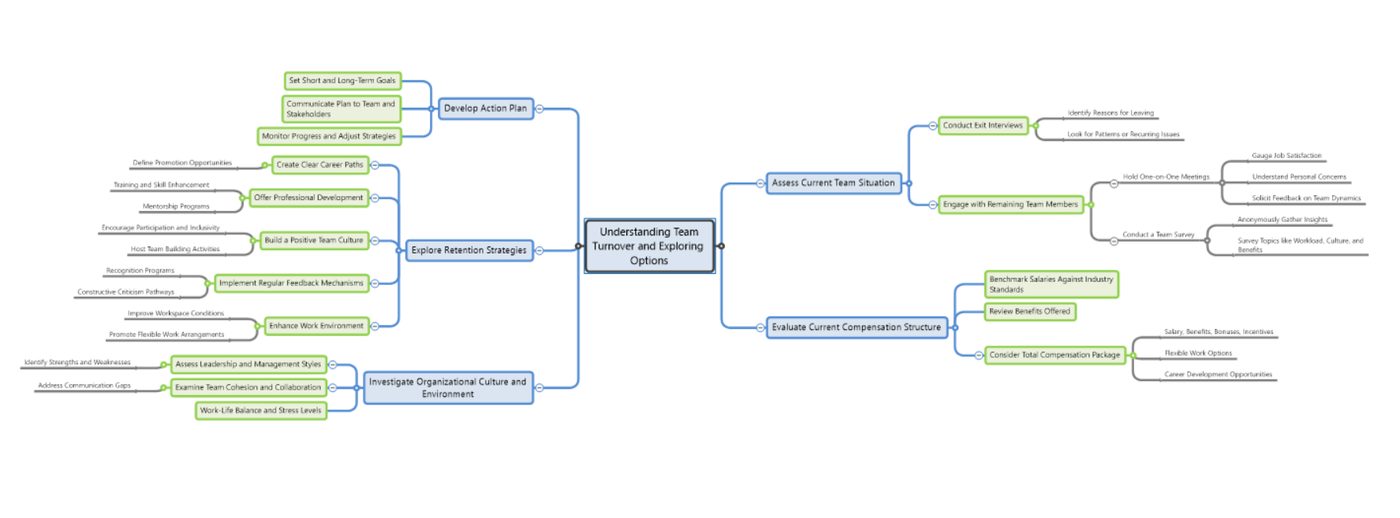
Main branches, as generated
- Assess Current Team Situation: Conduct Exit Interviews; Engage with Remaining Team Members
- Evaluate Current Compensation Structure
- Investigate Organizational Culture and Environment
- Explore Retention Strategies: Create Clear Career Paths; Offer Professional Development; Build a Positive Team Culture
- Develop Action Plan
A sensible list of things to do. It never asks whether the pay review is the right answer.
With the Structured Thinking prompt
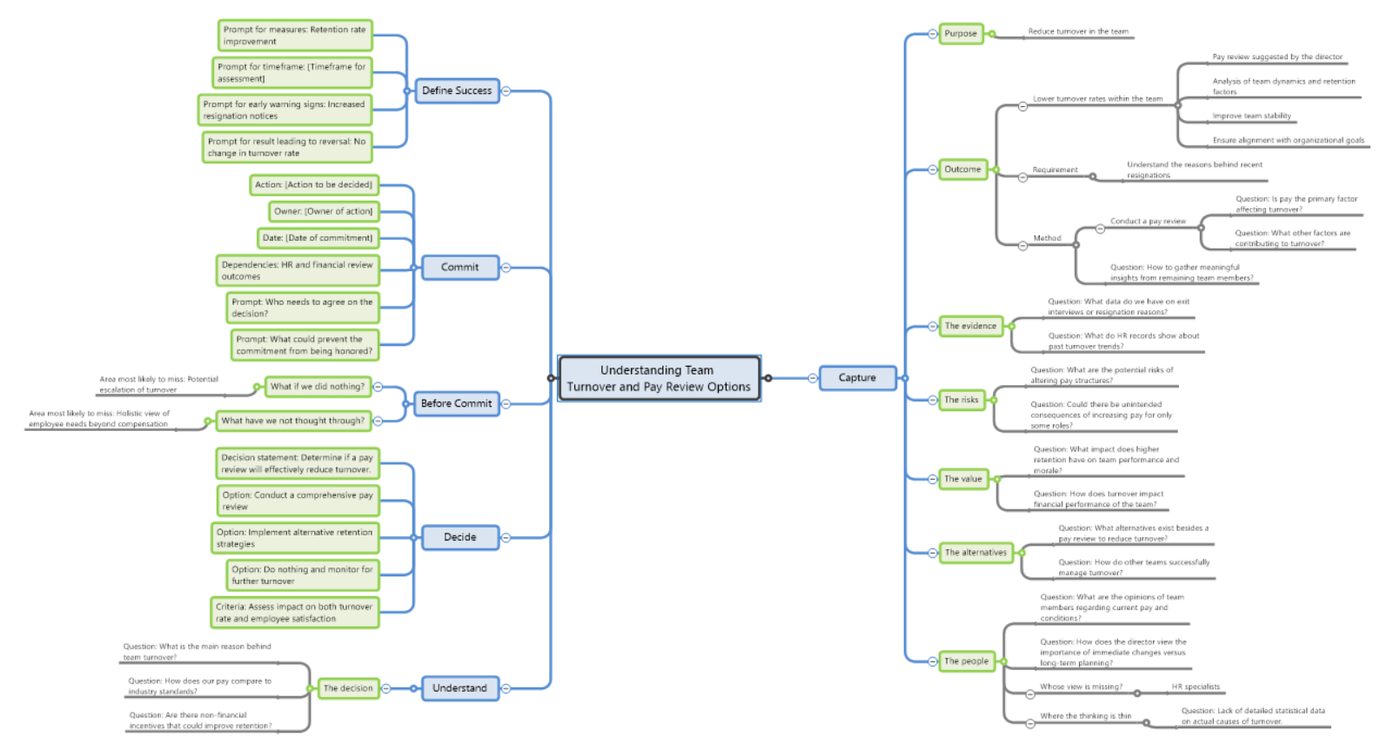
Selected branches, as generated
- Decision statement: Determine if a pay review will effectively reduce turnover.
- Question: Is pay the primary factor affecting turnover?
- Question: Could there be unintended consequences of increasing pay for only some roles?
- Whose view is missing? HR specialists
- Where the thinking is thin: Lack of detailed statistical data on actual causes of turnover.
- Option: Do nothing and monitor for further turnover
- Prompt for result leading to reversal: No change in turnover rate
It puts the suggested answer on trial before anyone acts.
What it put in front of us
The straight prompt was sensible. It starts by asking why people left, before any action. But it never decides anything: there is no view on the pay review, no alternative, no cost of doing nothing and no measure of success.
The Structured Thinking prompt made the director’s suggestion the decision itself, asked whether pay is really the cause, and raised a risk the first answer missed: raising pay for only some roles. It named what is missing, HR’s view and real data on why people left, made doing nothing a genuine option, and set the result that would reverse the decision. Where it did not know an owner or a date, it left a blank rather than inventing one.
One run of each, same problem, same day, in MindGenius AI. Maps shown in part and unedited; select a map to see it full size. A demonstration, not a measured comparison.
Why a mind map makes AI output more workable
AI often presents its output as a finished response. Important work rarely develops in a straight line: new information emerges, assumptions change and alternatives become clearer. A mind map gives you a visual workspace in which to see, rearrange and develop different parts of the thinking.
With MindGenius, an AI-generated starting point becomes material to examine rather than an answer to accept.
A mind map also keeps the structure of your thinking visible and editable. You can see where attention is concentrated, where alternatives are missing and where an area deserves closer examination: a flat map, a decision with only one option, a branch much thinner than the rest. These are prompts for questions, not verdicts. What the shape of a map can tell you
Keep what you know apart from what AI suggests
One habit makes AI suggestions safer to use: keep what you know, what you have inferred and what AI has suggested on separate branches, or mark them clearly. For example, in a review of customer support:
| Branch | Example |
|---|---|
| Known | Complaints have risen this quarter, from the support log |
| Inferred | Longer response times may be contributing |
| AI suggested | Investigate whether automated triage would help |
| Not yet established | Whether response times are actually the cause |
The AI suggestion may well be useful. Kept on its own branch, it stays a suggestion to test rather than quietly becoming a fact. And “not yet established” is a legitimate answer: it tells you what to find out next, instead of tempting you, or an AI, to fill the gap with something plausible.
Illustrative example.
Can you use Structured Thinking with other AI tools?
Yes. The method does not depend on MindGenius or on any particular AI assistant: instead of asking “What’s the best solution?”, ask what you are assuming, what alternatives you should consider, whose perspective is missing and what would happen if you did nothing. What MindGenius adds is somewhere for that thinking to live. Instead of scrolling away in a chat, it stays in a visual map you can come back to, reshape and build on as your understanding changes.
What AI cannot guarantee
AI cannot guarantee that the problem is correctly framed, that its information is accurate or that a proposed solution will succeed. Structured Thinking cannot guarantee those things either. It makes assumptions, alternatives, commitments and uncertainties visible while there is still time to examine them.
When is it worth the extra thought?
Not every question needs a method. For a quick fact, a first draft or a list of ideas, ask an AI directly. A more deliberate approach is worthwhile when:
- You have become responsible for something important and are unsure what has been missed.
- People see the situation differently.
- A decision would be expensive or difficult to reverse.
- The proposed solution is gathering agreement before alternatives are considered.
- Success has not been clearly defined.
Start with something you need to think through
Use AI to help you think further, not simply to finish faster.
Frequently asked questions
What is Structured Thinking in AI?
Structured Thinking is a deliberate way to frame problems, examine information, consider alternatives and make decisions. With AI, it guides what you ask, how you assess the responses and what you do next.
How can I get better results from AI?
Clarify the problem, give relevant context and constraints, ask for alternative interpretations, and check important claims before acting.
Is Structured Thinking just better prompting?
No. A good prompt can improve an AI response. Structured Thinking helps you examine the problem, challenge the assumptions and decide what to do with the response.
Can AI create mind maps?
Yes. MindGenius can generate an initial mind map from a prompt, for you to examine, reorganise and develop.
Can AI help me work through a difficult problem?
MindGenius can generate a tailored Structured Thinking framework from your description of a problem. It helps identify the questions to explore, but does not make the decision for you.
Can students use AI without having it write their assignments?
Yes. MindGenius provides an assignment-focused framework that helps students understand the requirements, organise their research and develop their own work.
Do I need AI to use MindGenius?
No. Every map, project and framework can be built without AI. MindGenius 20 has no AI in the build at all.
What does MindGenius send to the AI?
Only what a request needs. For branch-level suggestions, that is the selected branch and its path back to the centre of the map, and nothing else. When you start a map or framework from a prompt, it is the text you type. Requests are covered by the enterprise licensing terms of our AI provider, OpenAI. The AI and data ai-page has the full detail.
Take something you have been handed and do not yet fully understand. The free 14 day trial includes every feature.
Download Desktop Start Online free trialOr read the method first: The Structured Thinking Handbook · Frameworks