
Structured Thinking Software · The Project Nerve Centre
A mind map is not just for day one. It is how you run the work every day after.
Most people think a mind map is for planning something at the start, then it goes in a drawer. That misses the biggest payoff. The map is where the project actually lives: the agenda, the action plan, the one version of status truth and the minutes, the thing you open many times a day rather than build once and file.
Run the project, and the business, on one shared map. Because the real status of every action is on screen, owned and dated, the conversation is about the work rather than about who can describe it best. There is no hiding place.
Most projects are run on reports that describe the work, not the work itself. The report says green. The project is not green. By the time the gap shows, the moment to act on it has passed. This is a way of running work where reality is on screen, so the green report and the real project are the same thing.
What you are looking at
One map. The whole project. Today's discipline in full focus.
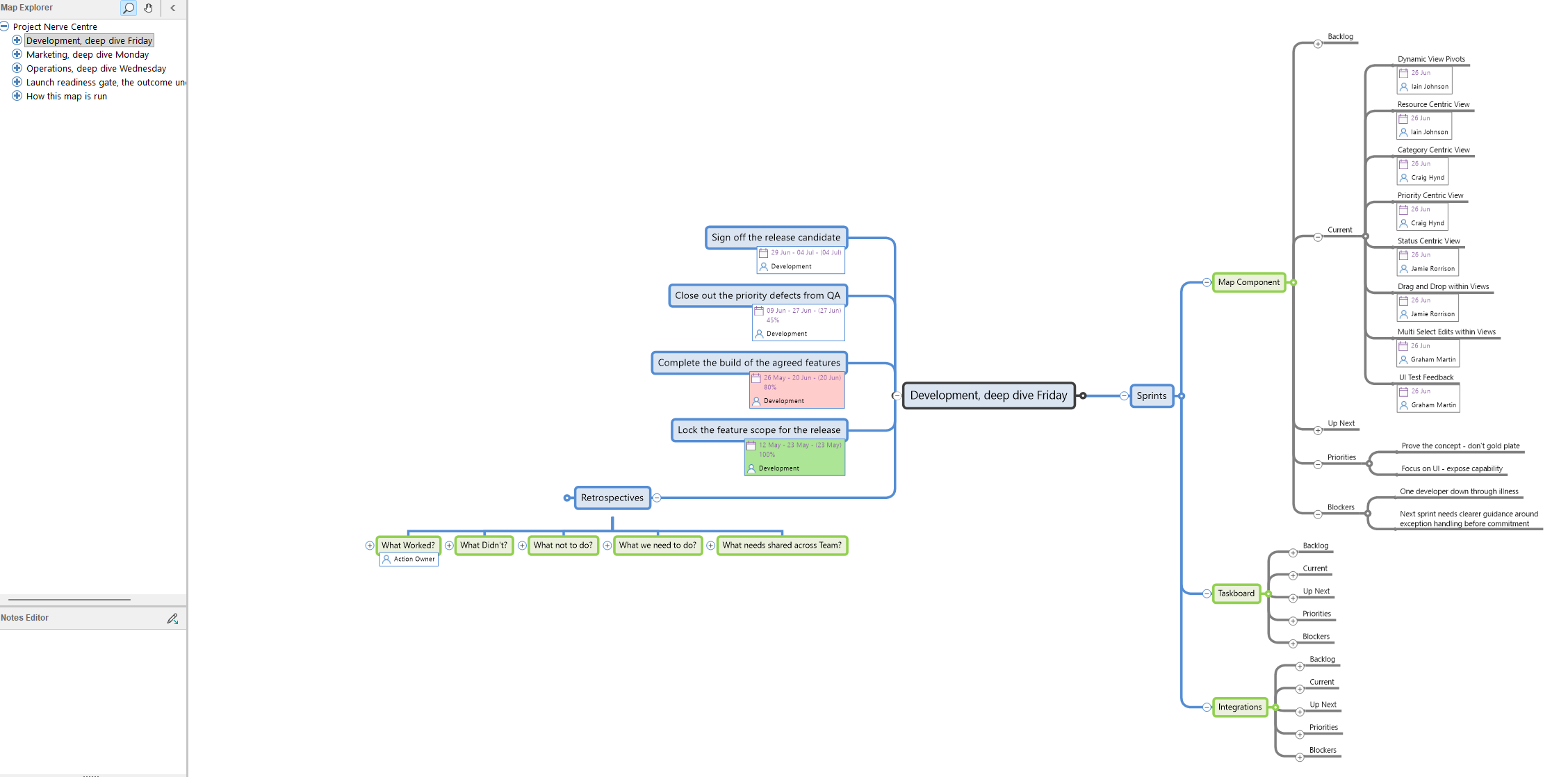
This is a project map mid-flight, not a tidy template. Status is visible, owned and dated, so you can see what is actually done.
Focus on one thing without forgetting the rest
Collapse everything except the discipline under review and the canvas gives you that one stream in full depth, nothing competing for attention. The Map Explorer still shows the whole project beside it. A report cannot collapse. A board shows you everything always, or you filter and lose the rest. The map does both at once: full focus, full context.
Owned and dated
Each agreed outcome is a task with a named owner and a date, so "that is with the other team" has a name against it and a day it is due.
Granulated, so "nearly there" has to resolve
Sizeable outcomes break into sub-tasks. "Nearly there" has to become which sub-tasks are actually done. The granularity is the truth serum.
Pre-prepared, not collected on the day
Owners update their own tasks before the meeting, so the meeting reads real status rather than gathering a comfortable version of it in the room.
One shared map, carried forward
The same map is on screen for everyone, and last meeting's outcomes are right there. There is no private version where the story is rosier, and nothing quietly stalls between meetings.
One source, many views
One source of truth. Many ways to see it.
The same project answers a different question depending on what you need to know. You don't move the work between tools. You look at the same underlying project information in the way that suits the job in front of you.
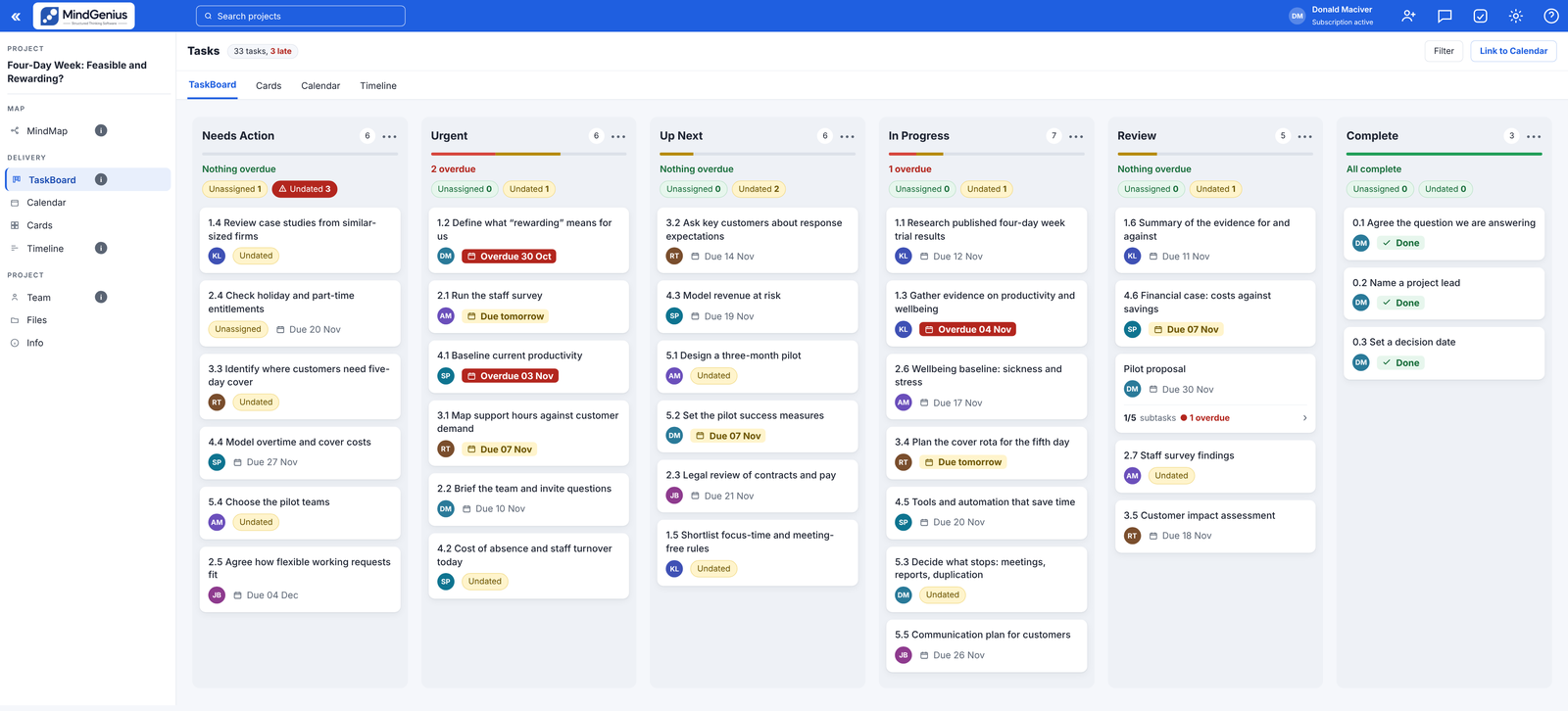
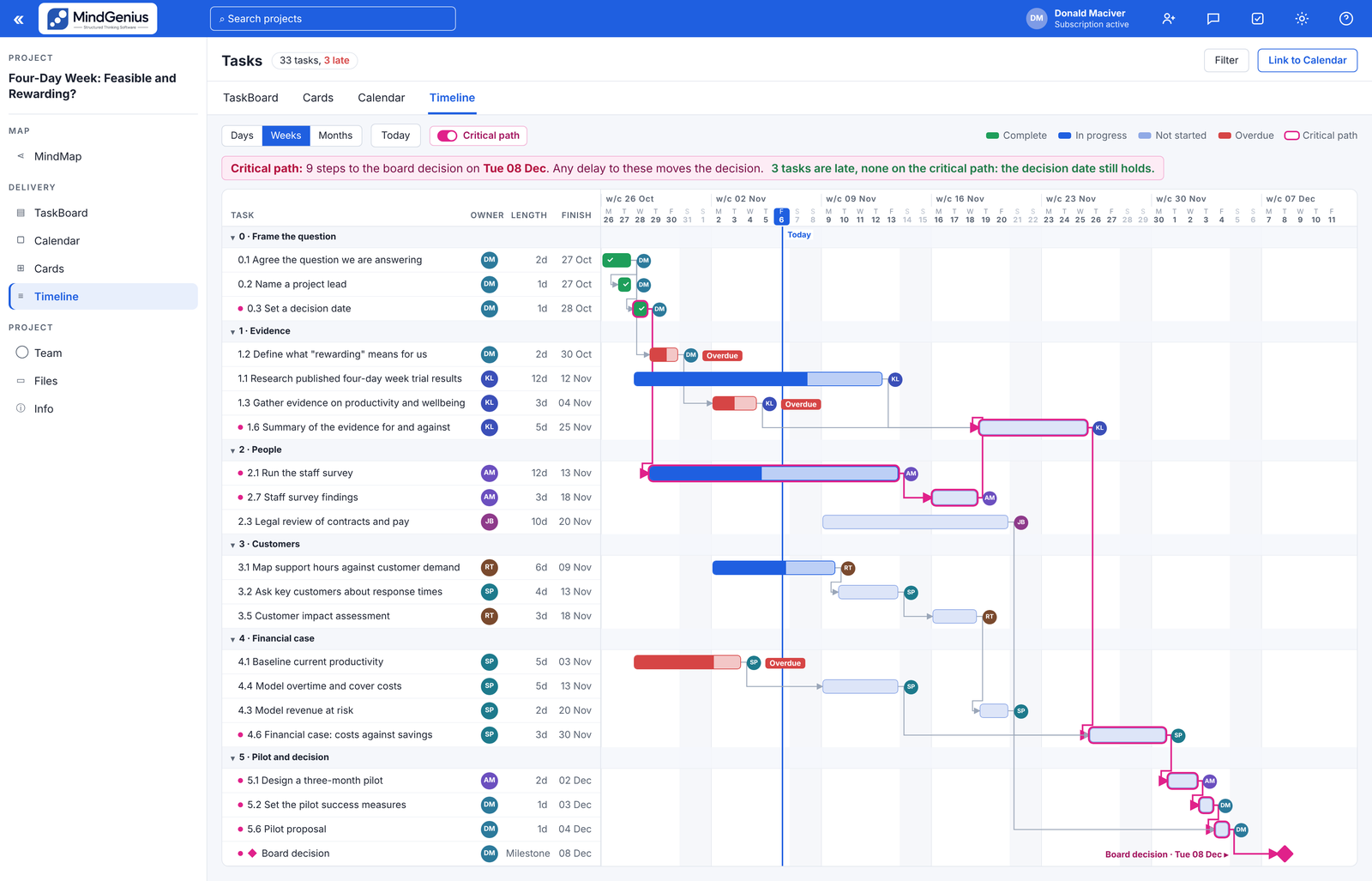
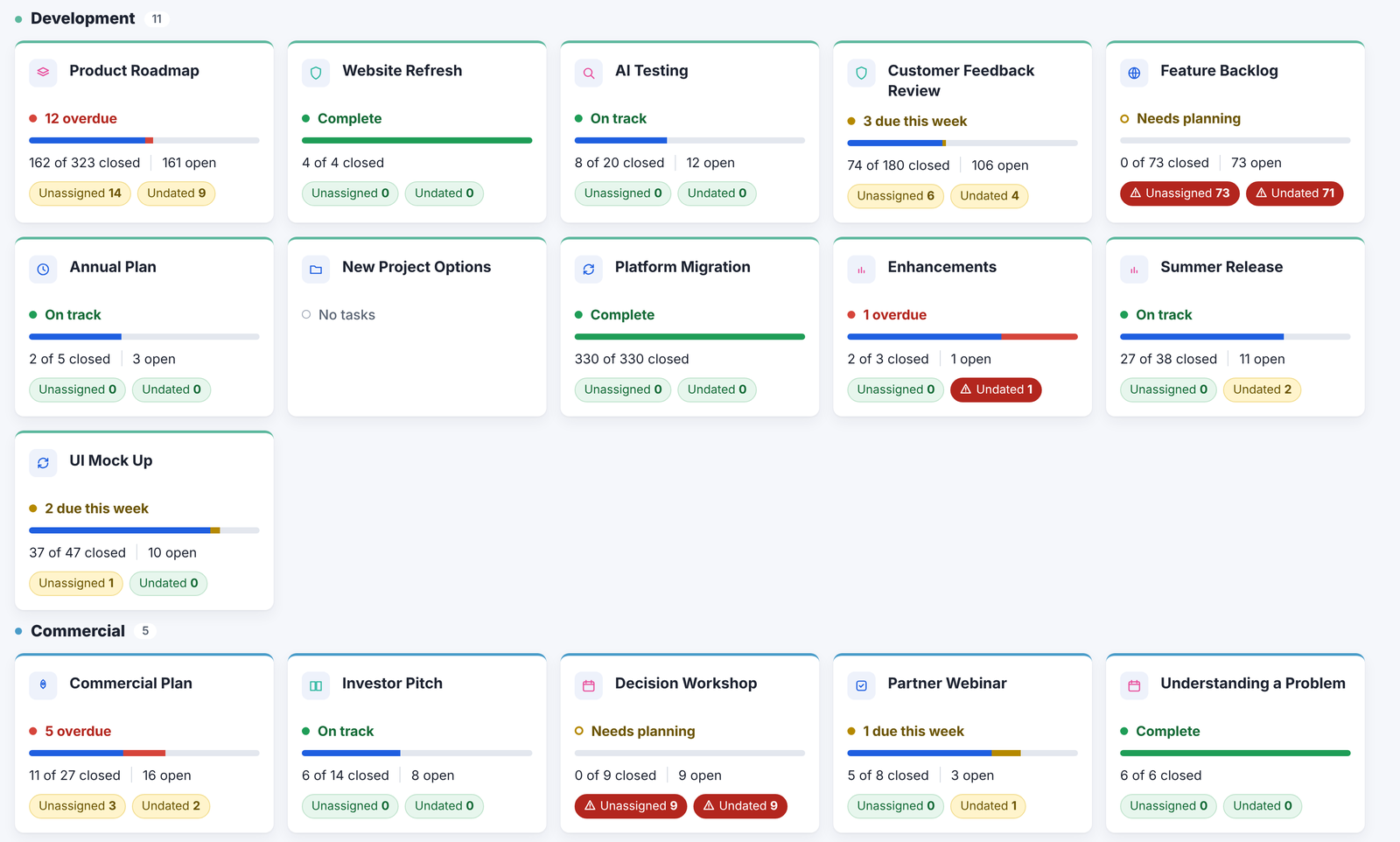
These are not five versions of the project. They are five ways of looking at the same information.
Update it anywhere. It is true everywhere.
One structured source, so you can cut across it
Because it is all the same underlying information, you can ask the whole project a question at once. Every overdue action by owner. Everything blocked across the project. Who is overloaded across different workstreams. What needs attention, without anyone stitching together another report.
Good views, one project
A board is a good way to see work moving. A Gantt is a good way to see time. A resource view is a good way to see capacity. The trouble only starts when each one becomes a separate version of the project. Here they are all the same information, so there is nothing to reconcile.
Different jobs, same truth
The project manager can work in the Gantt. The delivery team can work from the board. The resource manager can look at capacity. Nobody is keeping a separate version. Different roles. Different views. Same underlying truth.
The cascade
It is not a meeting. It is the same instrument at every level.
Status flows up without a translation layer where the truth can soften. The map a director brings is not their summary of how things are going. It is the actual state their section heads have already faced.
Same map. Same data. No translation layer.
What reaches the top is not a description of the work. It is the work.
The rhythm
Three deep dives a week, with a standing early-warning window.
On a major project, each meeting is a deep dive on one discipline. The first fifteen minutes belong to everyone, so a weak signal in one stream cannot sit unheard for a week while it compounds.
The cadence is the heartbeat. The map is where the truth lives between beats.
What it gives you
The gaps become obvious. The weaknesses show up early.
Too often you sit in a meeting and hear half-truths meant to deflect. This removes that. The conversation moves to the work, not to who can describe it best.
Here is a framework for running a project this way.
Open the Project Nerve Centre framework and make it yours. Agreed outcomes are already set up as tasks that carry an owner and a date, with one outcome broken into sub-tasks so you can see the pattern. Keep what helps, delete the rest.