
Bowtie risk thinking
The bowtie is one of the clearest risk diagrams ever invented: the threats that lead to an event on the left, the event in the middle, the consequences on the right, and the controls that guard each side. It is a brilliant way to communicate risk. It is a poor way to discover it. Exploration and structure are different activities, and the bowtie is all structure. Its tight format makes you commit to a shape before you have found what is really there, the threat you had not considered, or the two harmless things that become dangerous together. So explore first, in a space built for it. Then tie the bowtie.
Desktop downloads a file you open in MindGenius. Online opens the framework so you can look at it first, then add it to your portfolio.
No MindGenius yet? Download Desktop or start an Online trial.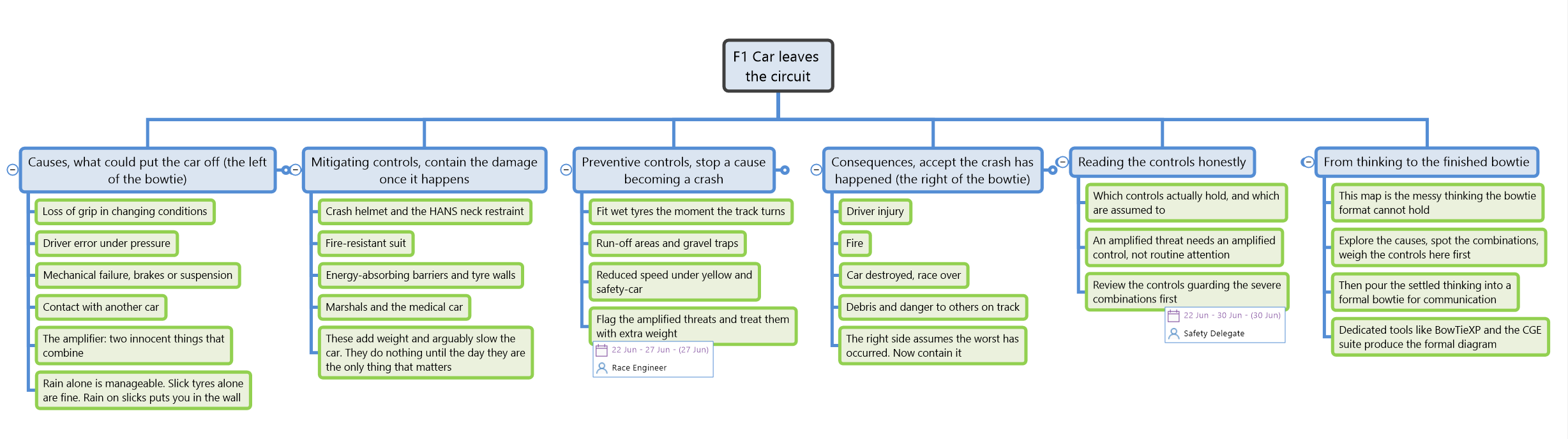
Modern Formula 1 is dramatically safer than it used to be, not because it got better at preventing crashes, but because it assumed crashes will happen and invested in surviving them.
That is the whole point of a bowtie. It forces you to plan for the failure you hope never comes, not just to prevent it. The left side stops the car leaving the track. The right side assumes it has, and works to keep that from becoming a tragedy.
Think it through loose, then tie the bowtie
This map uses one worked example, an F1 car leaving the circuit, to think through both halves of a bowtie before committing to the format. The thinking stays open. Only the real commitments, flagging the amplified threats and reviewing the controls that guard the severe combinations, become tracked tasks.
A bowtie is the final answer. This map is where you challenge whether the answer is correct.
Causes, the left of the bowtie
- Loss of grip, driver error, mechanical failure, contact
- The amplifier: two innocent things that combine into one dangerous one
- Rain alone is manageable. Slick tyres alone are fine. Rain on slicks puts you in the wall
- The same pattern outside racing: a key person on leave and a supplier running late, a weak password and a convincing phishing email. Neither is fatal alone
Preventive controls, stop a cause becoming a crash
- Fit wet tyres the moment the track turns
- Run-off areas, reduced speed under yellow and safety-car
- Flag the amplified threats and treat them with extra weightRace Engineer
Consequences, the right of the bowtie
- Driver injury, fire, car destroyed, debris on track
- The right side assumes the worst has occurred. Now contain it
Mitigating controls, contain the damage
- Helmet and HANS, fire-resistant suit, energy-absorbing barriers, marshals
- They add weight and arguably slow the car. They do nothing until the day they are the only thing that matters
Reading the controls honestly
- Which controls actually hold, and which are only assumed to
- An amplified threat needs an amplified control, not routine attention
- Review the controls guarding the severe combinations firstSafety Delegate
From thinking to the finished bowtie
- This map is the messy thinking the bowtie format cannot hold
- Explore the causes, spot the combinations, weigh the controls here first
- Then take the settled thinking into a dedicated bowtie tool such as BowTieXP or the CGE suite, which produce the formal diagram for communication