
Client Master Map
Everything you know about an account, held on one structured map instead of scattered across inboxes. Who they are, what they have, why they bought, and where the relationship actually stands, in one place your whole team can pick up. A filing system records what an account is. This map records what you understand about it, the champion who wants you to succeed, the promise made on the last visit, the renewal risk worth acting on now. That understanding is what keeps the account, not the data.
An account that lives in one person's head is an account you are one resignation away from losing.
Desktop downloads a file you open in MindGenius. Online opens the framework so you can look at it first, then add it to your portfolio.
No MindGenius yet? Download Desktop or start an Online trial.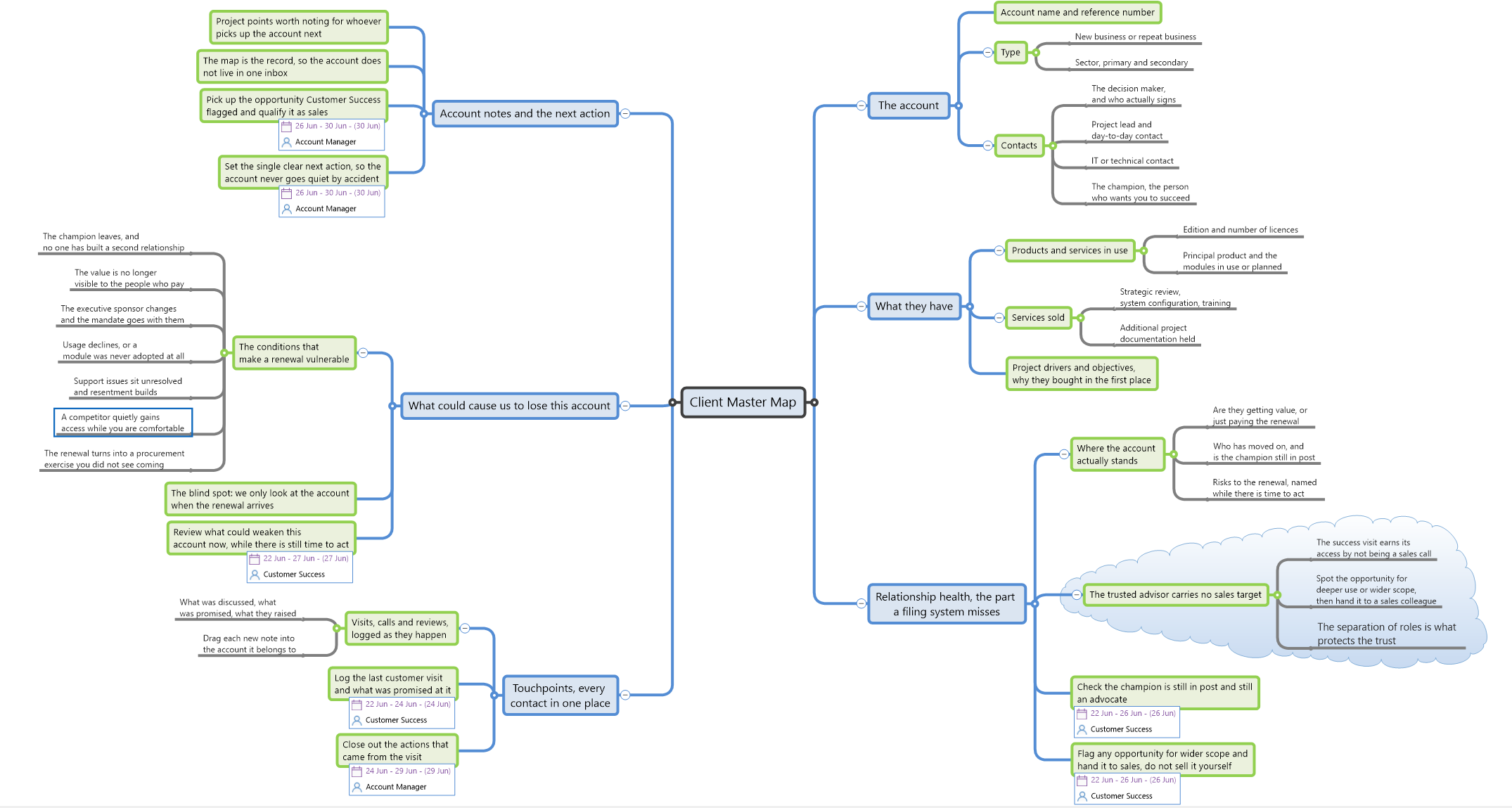
What's in the template
A worked account, not a blank form. The map keeps the full commercial record, then adds the things a filing system never holds: why they bought in the first place, how healthy the relationship actually is, and every touchpoint in one place. Three years on, everyone remembers the licence count and no one remembers the original pain that justified it. Anyone can pick this map up and read where the account stands, and why it started. The record stays as notes; only the genuine follow-ups become tracked tasks.
A CRM records transactions. A Customer Success process builds understanding. The transaction explains what the customer bought; the understanding explains why they stay.
The account
- Account name and reference number, type (new or repeat), sector primary and secondary
- Contacts: the decision maker and who signs, the project lead, the IT contact, and the champion, the person who wants you to succeed
What they have
- Products and services in use: edition and licences, principal product and modules in use or planned
- Services sold: strategic review, configuration, training, and the documentation held
- Why they bought in the first place. The original pain, who felt it, and what success was meant to look like. It is the first thing forgotten and the most important thing to remember, because it is where the value conversation restarts
Relationship health, the part a filing system misses
- Where the account actually stands: are they getting value or just paying the renewal, who has moved on, is the champion still in post, and which renewal risks are worth acting on now
- The trusted advisor carries no sales target. The success visit earns its access by not being a sales call. Spot the opportunity for deeper use or wider scope, then hand it to a sales colleague. The separation of roles is what protects the trust
- Check the champion is still in post and still an advocateCustomer Success
- Flag any opportunity for wider scope and hand it to sales, do not sell it yourselfCustomer Success
Touchpoints, every contact in one place
- Visits, calls and reviews logged as they happen: what was discussed, what was promised, what they raised
- Log the last customer visit and what was promised at itCustomer Success
- Close out the actions that came from the visitAccount Manager
What could cause us to lose this account
- The conditions that make a renewal vulnerable: the champion leaves and no second relationship was built, the value is no longer visible to the people who pay, the sponsor changes and the mandate goes with them, usage declines or a module was never adopted, support issues sit unresolved, a competitor quietly gains access, the renewal turns into a procurement exercise you did not see coming
- The blind spot: we only look at the account when the renewal arrives.
- Review what could weaken this account now, while there is still time to actCustomer Success
Account notes and the next action
- Project points worth noting for whoever picks up the account next
- Pick up the opportunity Customer Success flagged and qualify it as salesAccount Manager
- Set the single clear next action, so the account never goes quiet by accidentAccount Manager
Why the success visit is not a sales call
The most valuable account visits are the ones the customer does not have to be guarded about. A trusted advisor who carries no sales target earns access a salesperson never gets, because the customer knows the visit is about their success, not the next order. When that advisor spots a real opportunity, deeper use of what they have or a wider scope, the discipline is to hand it to a sales colleague rather than act on it. The separation is the point: the moment a success visit is suspected of being a stealth sales call, the trust that made it valuable is gone. One worked rhythm for this is a sector specialist visiting each account on a regular cadence, every six months, with the hand-off, not the close, as their job. The map holds both sides honestly: who spotted the opportunity, and who is carrying it forward.