
Dissertation
A dissertation looks like a document you write from the first page to the last. It is really a sequence of decisions, and the expensive ones are made early and surface late: the question that turns out too broad to answer, the gap that was never really a gap, the method that cannot speak to what you asked. The chapter structure is the easy part. What determines both how hard the writing is and how good the result is, is the quality of the argument running through it. Get that right before you start and most of the writing follows. Get it wrong and no amount of editing saves it.
A dissertation is not a document you write start to finish. It is a sequence of decisions, held together by an argument. The map is where you see whether it holds together before you write 15,000 words against it.
Desktop downloads a file you open in MindGenius. Online opens the framework so you can look at it first, then add it to your portfolio.
No MindGenius yet? Download Desktop or start an Online trial.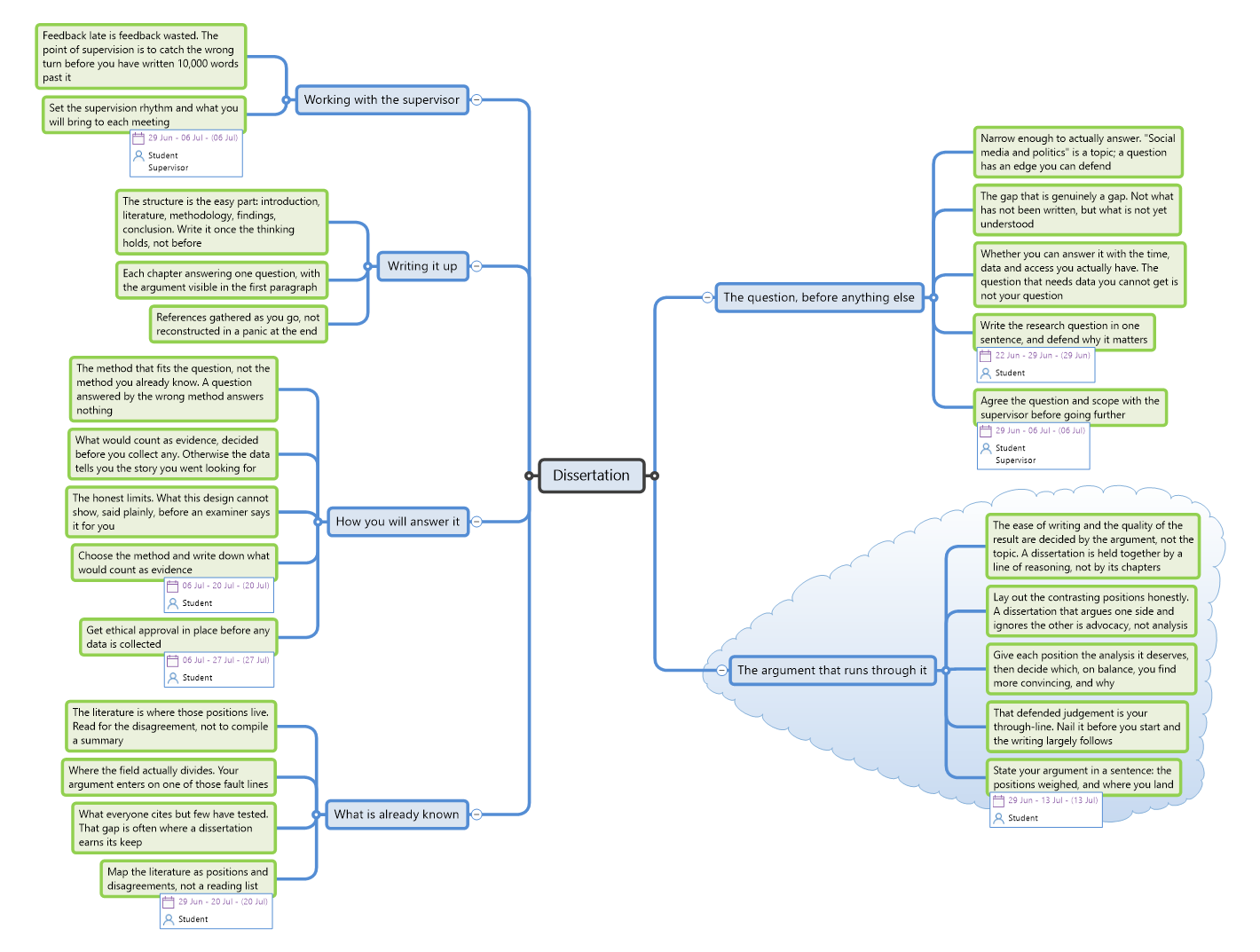
This framework structures the dissertation once the research direction is settled. Working out what deserves to become the research question is earlier work, and it happens on a map too.
What's in the template
A worked plan in the order the decisions are actually made, not the order the chapters appear. The question and the argument carry the weight, because they are settled before a word of the dissertation is written and everything downstream depends on them. The thinking stays open. Only the genuine commitments become tracked tasks.
A dissertation that argues one side and ignores the other is advocacy, not analysis. Weigh the positions, decide where you land, and carry that judgement as your through-line.
The question, before anything else
- Narrow enough to actually answer. "Social media and politics" is a topic; a question has an edge you can defend
- The gap that is genuinely a gap. Not what has not been written, but what is not yet understood
- Whether you can answer it with the time, data and access you actually have. The question that needs data you cannot get is not your question
- Write the research question in one sentence, and defend why it mattersStudent
- Agree the question and scope with the supervisor before going furtherStudentSupervisor
The argument that runs through it
- The ease of writing and the quality of the result are decided by the argument, not the topic. A dissertation is held together by a line of reasoning, not by its chapters
- Lay out the contrasting positions honestly. A dissertation that argues one side and ignores the other is advocacy, not analysis
- Give each position the analysis it deserves, then decide which, on balance, you find more convincing, and why
- That defended judgement is your through-line. Nail it before you start and the writing largely follows
- State your argument in a sentence: the positions weighed, and where you landStudent
What is already known
- The literature is where those positions live. Read for the disagreement, not to compile a summary
- Where the field actually divides. Your argument enters on one of those fault lines
- What everyone cites but few have tested. That gap is often where a dissertation earns its keep
- Map the literature as positions and disagreements, not a reading listStudent
How you will answer it
- The method that fits the question, not the method you already know. A question answered by the wrong method answers nothing
- What would count as evidence, decided before you collect any. Otherwise the data tells you the story you went looking for
- The honest limits. What this design cannot show, said plainly, before an examiner says it for you
- Choose the method and write down what would count as evidenceStudent
- Get ethical approval in place before any data is collectedStudent
Writing it up
- The structure is the easy part: introduction, literature, methodology, findings, conclusion. Write it once the thinking holds, not before
- Each chapter answering one question, with the argument visible in the first paragraph
- References gathered as you go, not reconstructed in a panic at the end
Working with the supervisor
- Feedback late is feedback wasted. The point of supervision is to catch the wrong turn before you have written 10,000 words past it
- Set the supervision rhythm and what you will bring to each meetingStudentSupervisor
Why this is the part that matters
Reference managers store your sources. Word processors hold the chapters. Neither does the part that decides the grade: sitting with the whole shape of the dissertation in view, seeing where the argument is thin, where two chapters quietly contradict each other, where the method cannot answer the question you actually asked. That is exploration before commitment, and it is exactly where a visual map earns its place. The writing tools take over once the thinking holds. MindGenius is built for the thinking that comes first.