Doing the right things
The first decision you make about a project is the deepest. Set off down the wrong path and it does not matter how well you execute, you will deliver the wrong thing brilliantly. This map is about the cut you make before any work starts. It takes its lead from the shift PMBOK 7 made, from asking what disciplines a project manager performs to asking what outcomes a project achieves, and turns that into eight plain questions. It is our simplified, outcome-first interpretation, not the formal framework.
Desktop downloads a file you open in MindGenius. Online opens the framework so you can look at it first, then add it to your portfolio.
No MindGenius yet? Download Desktop or start an Online trial.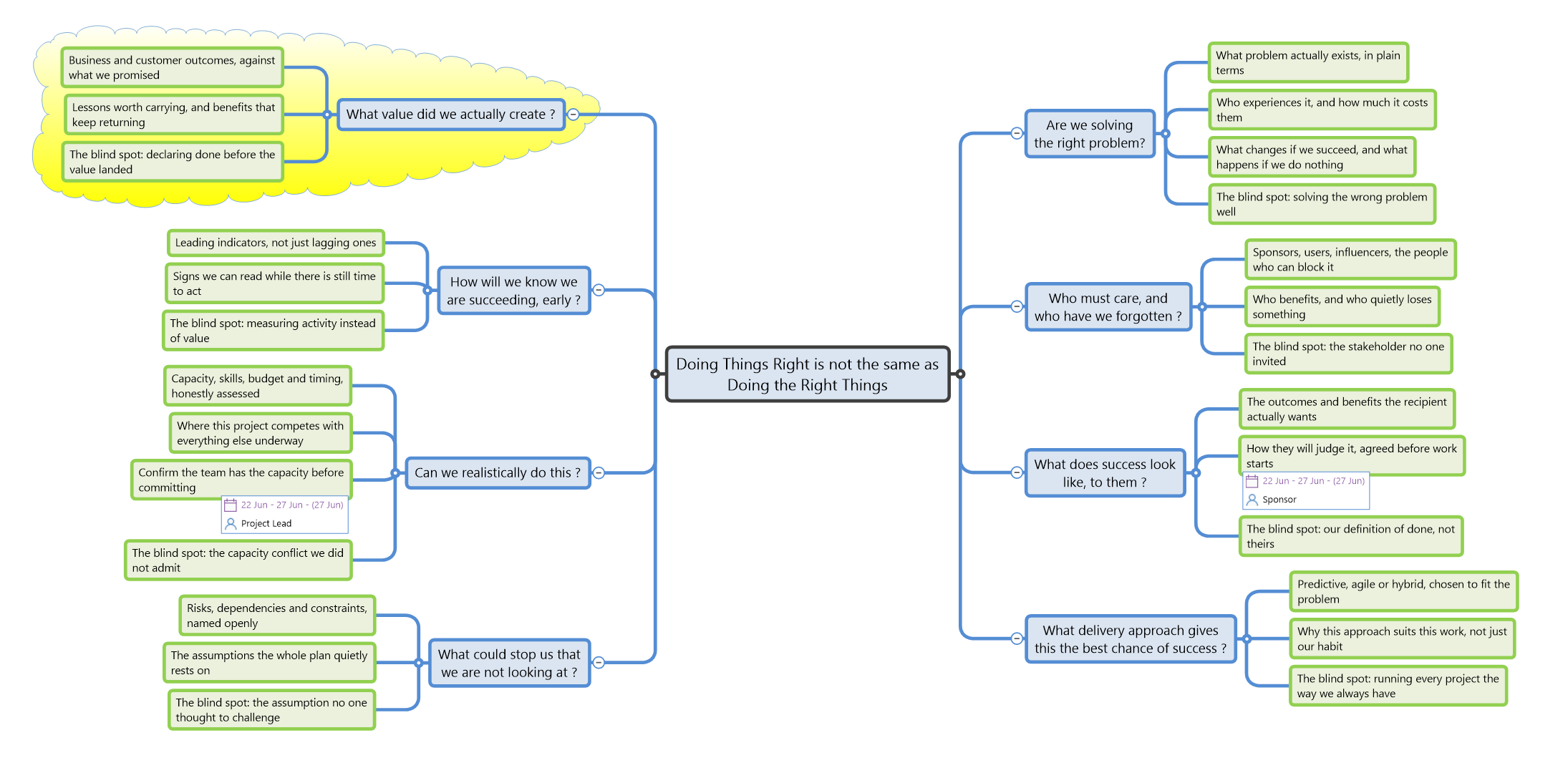
Doing things right is not the same as doing the right things.
A project can be run flawlessly and still deliver the wrong outcome. These eight questions are the cut you make before any work starts, and the blind spot beside each one is the thing teams most often miss.
Eight questions that decide a project before it starts
This is not a checklist of management activities. It is a way of pressure-testing whether a project will create value or merely complete work. Seven of the questions come before commitment, the cut you make before any work starts. The eighth comes after delivery, and asks whether the value actually landed. The questions stay as open thinking. Only the two genuine commitments, agreeing how success will be judged and confirming the team has the capacity, become tracked tasks.
Every branch ends with a blind spot. The thing most likely to be missed, ignored or assumed.
Are we solving the right problem
- What problem actually exists, in plain terms
- Who experiences it, and how much it costs them
- What changes if we succeed, and what happens if we do nothing
- Blind spot: solving the wrong problem well
Who must care, and who have we forgotten
- Sponsors, users, influencers, the people who can block it
- Who benefits, and who quietly loses something
- Blind spot: the stakeholder no one invited
What does success look like, to them
- The outcomes and benefits the recipient actually wants
- How they will judge it, agreed before work startsSponsor
- Blind spot: our definition of done, not theirs
What delivery approach gives this the best chance of success
- Predictive, agile or hybrid, chosen to fit the problem
- Why this approach suits this work, not just our habit
- Blind spot: running every project the way we always have
What could stop us that we are not looking at
- Risks, dependencies and constraints, named openly
- The assumptions the whole plan quietly rests on
- Blind spot: the assumption no one thought to challenge
Can we realistically do this
- Capacity, skills, budget and timing, honestly assessed
- Where this project competes with everything else underway
- Confirm the team has the capacity before committingProject Lead
- Blind spot: the capacity conflict we did not admit
How will we know we are succeeding, early
- Leading indicators, not just lagging ones
- Signs we can read while there is still time to act
- Blind spot: measuring activity instead of value
What value did we actually create
- Business and customer outcomes, against what we promised
- Lessons worth carrying, and benefits that keep returning
- Blind spot: declaring done before the value landed