
Financial Planning
A financial plan looks like a record of someone's numbers. It is really a set of assumptions about a future that has not happened yet: the return quietly counted on, the income assumed to continue, the risks not yet priced. The numbers are the easy part. The adviser's real work is making those assumptions visible to the client, and testing them, before either party commits to a plan built on them. A plan you cannot stress-test is a wish with a spreadsheet attached.
A financial plan is a set of assumptions about a future that has not happened. The value is seeing which assumptions you are actually betting on.
Desktop downloads a file you open in MindGenius. Online opens the framework so you can look at it first, then add it to your portfolio.
No MindGenius yet? Download Desktop or start an Online trial.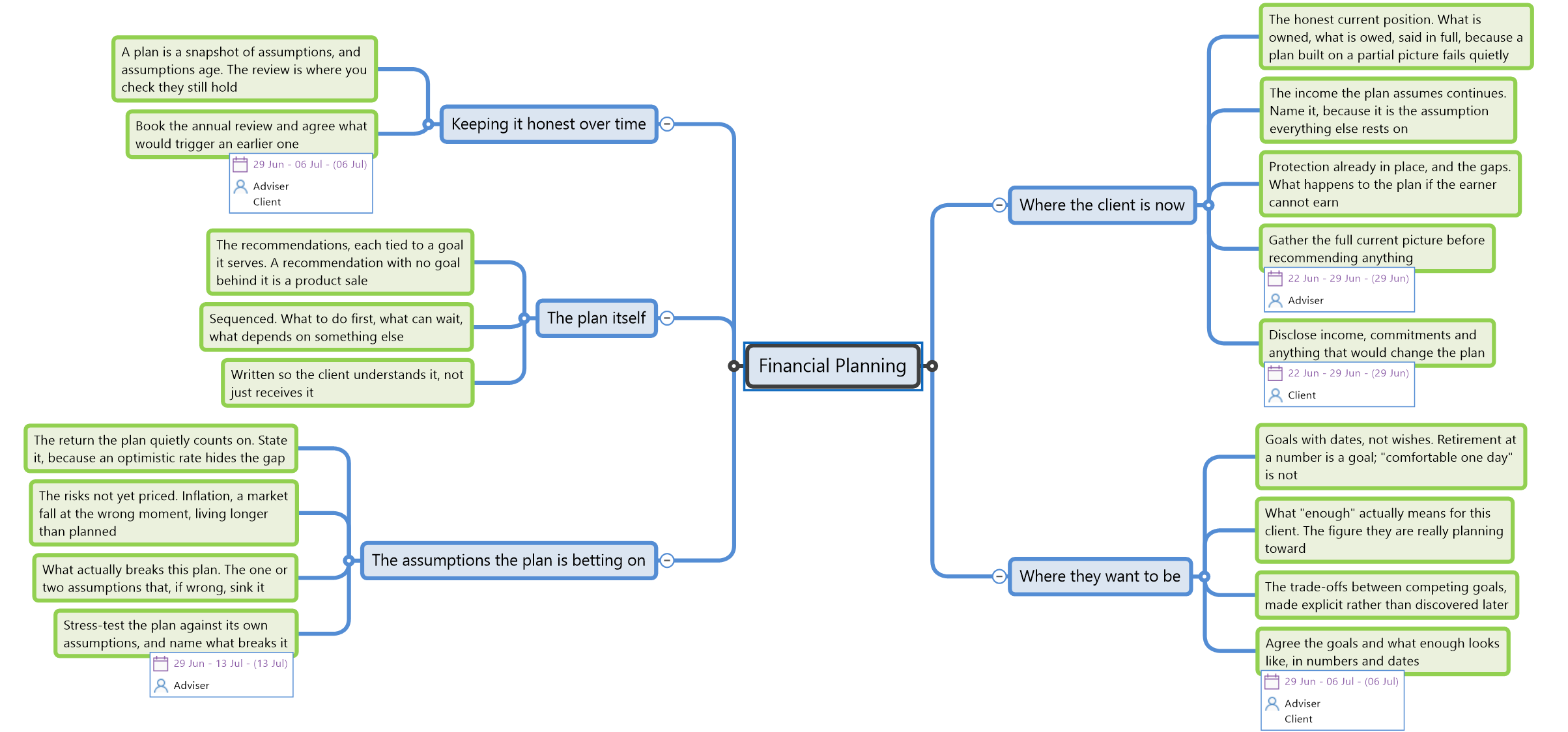
What's in the template
A worked plan built with the client, not a blank checklist. The map runs from the honest current position to the review that keeps the plan honest over time, and the assumptions branch carries the weight, because the assumptions are the part most plans leave unsaid. Discovery stays open. Only the genuine commitments become tracked tasks.
A recommendation with no goal behind it is a product sale, and a plan you have not stress-tested is a wish. Surface the assumptions first, then decide.
Where the client is now
- The honest current position. What is owned, what is owed, said in full, because a plan built on a partial picture fails quietly
- The income the plan assumes continues. Name it, because it is the assumption everything else rests on
- Protection already in place, and the gaps. What happens to the plan if the earner cannot earn
- Gather the full current picture before recommending anythingAdviser
- Disclose income, commitments and anything that would change the planClient
Where they want to be
- Goals with dates, not wishes. Retirement at a number is a goal; "comfortable one day" is not
- What "enough" actually means for this client, the figure they are really planning toward
- The trade-offs between competing goals, made explicit rather than discovered later
- Agree the goals and what enough looks like, in numbers and datesAdviserClient
The assumptions the plan is betting on
- The return the plan quietly counts on. State it, because an optimistic rate hides the gap
- The risks not yet priced: inflation, a market fall at the wrong moment, living longer than planned
- What actually breaks this plan. The one or two assumptions that, if wrong, sink it
- Stress-test the plan against its own assumptions, and name what breaks itAdviser
The plan itself
- The recommendations, each tied to a goal it serves. A recommendation with no goal behind it is a product sale
- Sequenced: what to do first, what can wait, what depends on something else
- Written so the client understands it, not just receives it
Keeping it honest over time
- A plan is a snapshot of assumptions, and assumptions age. The review is where you check they still hold
- Book the annual review and agree what would trigger an earlier oneAdviserClient
Why this is the part that matters
Every financial tool can store the numbers. A spreadsheet records what is owned and owed; a planning system runs the projections. What none of them do well is the part that comes first: sitting with the client and making the hidden assumptions visible, so the plan is understood rather than just delivered. That is exploration before commitment, and it is exactly where a visual map earns its place. The calculations start after the assumptions are agreed. MindGenius is built for the conversation that comes before.