
Group Work
The work that sinks a group project is almost never the work itself. It is the work nobody agreed to own: the task everyone assumed someone else had, the join between two people's parts that fell to neither, the missing contribution nobody had the standing to chase. The way to avoid all of it is to spend the first meeting on the group, not the work. Sort out who is good at what, decide who holds the thread, and agree how you will run before you split a single task. Get that right and the project mostly runs itself. Skip it and you spend the last week firefighting.
A group that divides the work before it has agreed how to work together is just sharing out the eventual argument. Sort the people first.
Desktop downloads a file you open in MindGenius. Online opens the framework so you can look at it first, then add it to your portfolio.
No MindGenius yet? Download Desktop or start an Online trial.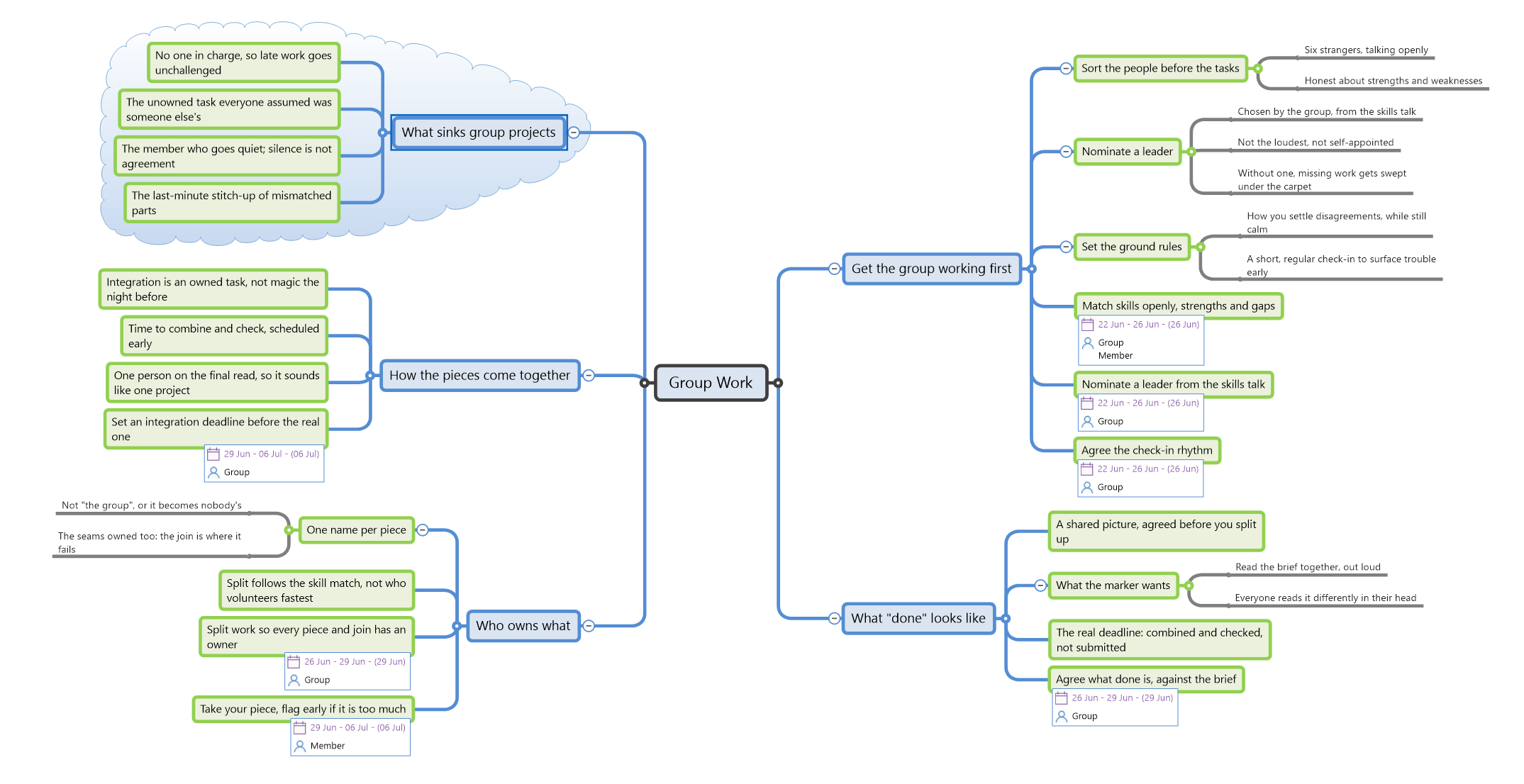
What's in the template
A worked plan in the order that actually decides whether a group project works: the people first, then the destination, then the split. The first branch carries the weight, because almost every group failure traces back to something that should have been settled at the first meeting. The thinking stays open. Only the genuine agreements become tracked tasks.
Shared ownership is how a task becomes nobody's. Every piece, and every join between pieces, needs one name against it.
Get the group working first
- Sort the people before the tasks. Six strangers have to talk openly, honest about what they are genuinely good at and what they are not. The skill match is what makes a sensible split possible later
- Out of that conversation, the group nominates a leader. Not the loudest, not self-appointed, but the person the group chooses because their strengths fit holding the thread and having the standing to say a part is late. Without one, missing work gets swept under the carpet while everyone else frets
- Set the ground rules: how you settle disagreements while everyone is still calm, and a short regular check-in to surface trouble while there is still time to act
- Match skills openly, naming strengths and gapsGroupMember
- Nominate a leader, chosen from the skills conversationGroup
- Agree the check-in rhythm and how a problem gets raised earlyGroup
What "done" looks like
- A shared picture of the finished thing, agreed before the work is split. A group that has not agreed the destination divides the work toward different places
- What the marker actually wants: read the brief together, out loud, because everyone reads it differently in their head
- The real deadline is when the work is combined and checked, not when it is submitted
- Agree as a group what the finished project has to be, against the briefGroup
Who owns what
- One name per piece, not "the group", because shared ownership is how a task becomes nobody's. The seams owned too: the join between two people's work is where projects quietly fall apart
- The split follows the skill match, not who volunteers fastest. Strengths matched to tasks, gaps named and covered
- Split the work so every piece, and every join, has one ownerGroup
- Take your piece, and flag early if it is more than you can doMember
How the pieces come together
- Integration is a task someone owns, not something that happens by magic the night before
- The time to combine the parts and check they fit, scheduled as its own deadline, earlier than feels necessary
- One person responsible for the final read, so the whole thing sounds like one project and not five stapled together
- Set an integration deadline before the real one, and name who owns itGroup
What sinks group projects
- No one in charge, so late and missing work goes unchallenged and lands on whoever cares most
- The unowned task everyone assumed was someone else's. It surfaces on the last day, every time
- The member who goes quiet. Silence is not agreement, and it is rarely fine
- The all-nighter to stitch mismatched parts together, because no one owned the join or scheduled the integration
Why this is the part that matters
Any group can divide a project into tasks and put dates against them. A shared document will happily hold the list. What a task list cannot do is the part that decides whether the project holds together: the honest conversation about who is good at what, the choice of who leads, the agreement on how to handle the member who goes quiet. Those are decisions made with the whole shape of the project in view, before the work is carved up. That is exploration before commitment. The shared docs and the task boards come after. MindGenius is built for the conversation that comes first.