
Lesson Plan
A lesson plan that lists what you will cover is a running order, not a plan. It tells you what happens and when, but not whether anyone learned anything. The harder and more useful question is the one most plans skip: what should students be able to do at the end that they could not at the start, and what would you see in the room that tells you they can. Plan backwards from that and the activities arrange themselves. Plan forwards from the activities and you can fill an hour without teaching a thing.
A busy, engaged classroom is not the same as a class that learned something. Decide what students should be able to do, and how you will know, before you plan the activities.
Desktop downloads a file you open in MindGenius. Online opens the framework so you can look at it first, then add it to your portfolio.
No MindGenius yet? Download Desktop or start an Online trial.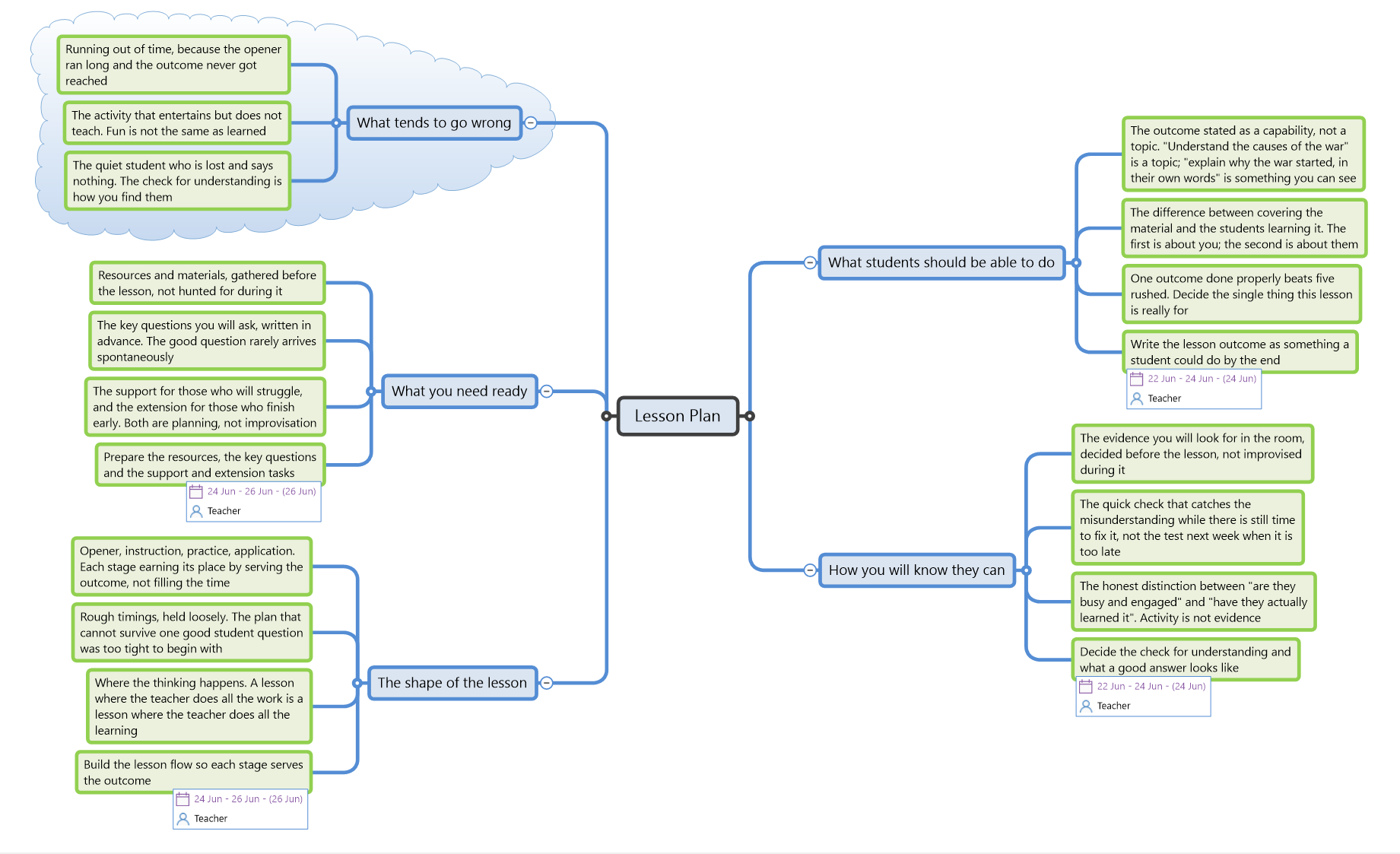
What's in the template
A worked plan in the order that produces good lessons: outcome first, evidence second, then the activities that serve them. The outcome and the check carry the weight, because a lesson planned without them can be busy, polished and still teach nothing. The thinking stays open. Only the genuine preparation becomes tracked tasks.
Covering the material is about you. The students learning it is about them. The plan that confuses the two fills the time and misses the point.
What students should be able to do
- The outcome stated as a capability, not a topic. "Understand the causes of the war" is a topic; "explain why the war started, in their own words" is something you can see
- The difference between covering the material and the students learning it. The first is about you; the second is about them
- One outcome done properly beats five rushed. Decide the single thing this lesson is really for
- Write the lesson outcome as something a student could do by the endTeacher
How you will know they can
- The evidence you will look for in the room, decided before the lesson, not improvised during it
- The quick check that catches the misunderstanding while there is still time to fix it, not the test next week when it is too late
- The honest distinction between "are they busy and engaged" and "have they actually learned it". Activity is not evidence
- Decide the check for understanding and what a good answer looks likeTeacher
The shape of the lesson
- Opener, instruction, practice, application. Each stage earning its place by serving the outcome, not filling the time
- Rough timings, held loosely. The plan that cannot survive one good student question was too tight to begin with
- Where the thinking happens. A lesson where the teacher does all the work is a lesson where the teacher does all the learning
- Build the lesson flow so each stage serves the outcomeTeacher
What you need ready
- Resources and materials, gathered before the lesson, not hunted for during it
- The key questions you will ask, written in advance. The good question rarely arrives spontaneously
- The support for those who will struggle, and the extension for those who finish early. Both are planning, not improvisation
- Prepare the resources, the key questions and the support and extension tasksTeacher
What tends to go wrong
- Running out of time, because the opener ran long and the outcome never got reached
- The activity that entertains but does not teach. Fun is not the same as learned
- The quiet student who is lost and says nothing. The check for understanding is how you find them
Why this is the part that matters
A lesson plan can be typed into any document, and the running order will look complete: opener, activity, plenary, homework. What a linear document hides is the question that decides whether the lesson works, which is whether every stage actually serves the one thing students are meant to leave able to do. Seeing the whole lesson at once, outcome and check and activities in a single view, is what surfaces the stage that fills time but teaches nothing. That is exploration before commitment. The slides and worksheets come after. MindGenius is built for the thinking that comes first.