
My Business Plan
Most business plans lead with the executive summary and bury the part that decides everything. This one starts where the work actually is: the target audience. Who they are, where they sit in the food chain, how they are hurting, and how that pain shows up. Then why the hurt persists when vendors already exist, which is where you are forced to be dramatically different relative to their needs, not in the abstract. Then why they would believe you, the reason to believe, anchored to their pain rather than your feature list. That language is deliberate. Dramatic Difference and a Real Reason to Believe are two of the three laws of Marketing Physics set out by Doug Hall in Jump Start Your Business Brain, alongside a clear Overt Benefit. Get the questions right and the numbers, the operations and the team are working out how to deliver a promise you have already proven is wanted, different and believable.
Desktop downloads a file you open in MindGenius. Online opens the framework so you can look at it first, then add it to your portfolio.
No MindGenius yet? Download Desktop or start an Online trial.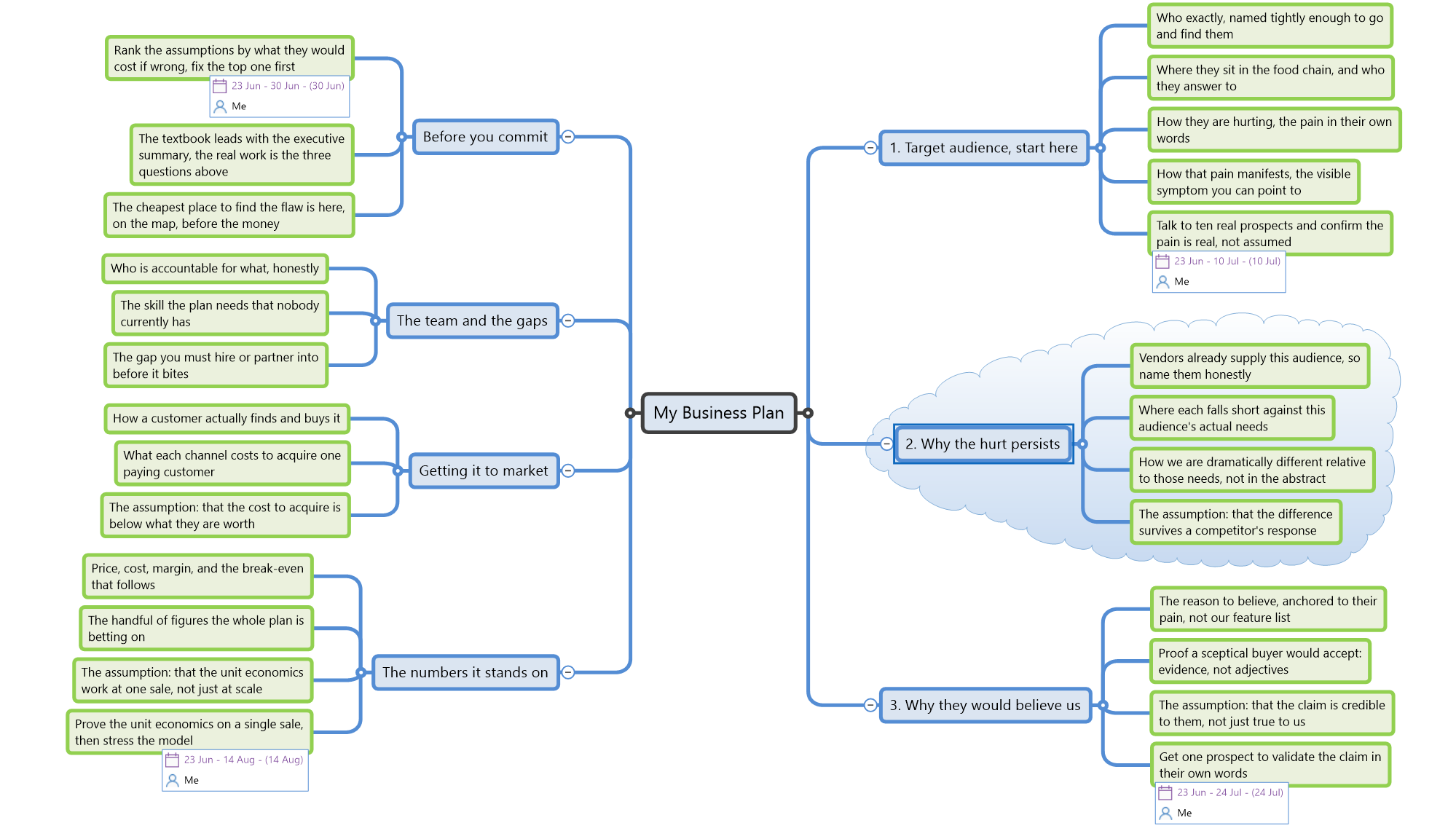
What's in the template
The first three branches are the plan. Audience, the gap, and credibility, in that order. The rest follows once those hold. The prompts stay exploratory, and the handful of things you must actually go and validate become dated tasks.
1. Target audience, start here
- Who exactly, named tightly enough to go and find them
- Where they sit in the food chain, and who they answer to
- How they are hurting, the pain in their own words
- How that pain manifests, the visible symptom you can point to
- Talk to ten real prospects and confirm the pain is real, not assumed
2. Why the hurt persists
- Vendors already supply this audience, so name them honestly
- Where each falls short against this audience's actual needs
- How you are dramatically different relative to those needs, not in the abstract
- The assumption: that the difference survives a competitor's response
3. Why they would believe us
- The reason to believe, anchored to their pain, not your feature list
- Proof a sceptical buyer would accept: evidence, not adjectives
- The assumption: that the claim is credible to them, not just true to you
- Get one prospect to validate the claim in their own words
The numbers it stands on
- Price, cost, margin, and the break-even that follows
- The handful of figures the whole plan is betting on
- The assumption: that the unit economics work at one sale, not just at scale
- Prove the unit economics on a single sale, then stress the model
Getting it to market
- How a customer actually finds and buys it
- What each channel costs to acquire one paying customer
- The assumption: that the cost to acquire is below what they are worth
The team and the gaps
- Who is accountable for what, honestly
- The skill the plan needs that nobody currently has
- The gap you must hire or partner into before it bites
Before you commit
- Rank the assumptions by what they would cost if wrong, fix the top one first
- The textbook leads with the executive summary. The real work is the three questions above
- The cheapest place to find the flaw is here, on the map, before the money