
Project Retrospective
A retrospective is how a group of individuals becomes a team. It is the debrief of the sprint that was, a chance to vent the friction and confusion honestly, to learn together from what everyone lived through, and to ask the harder question of whether we were set up to succeed at all. Get that right and the actions follow on their own. Treat it as a form to fill in and you get neither the trust nor the change.
Desktop downloads a file you open in MindGenius. Online opens the framework so you can look at it first, then add it to your portfolio.
No MindGenius yet? Download Desktop or start an Online trial.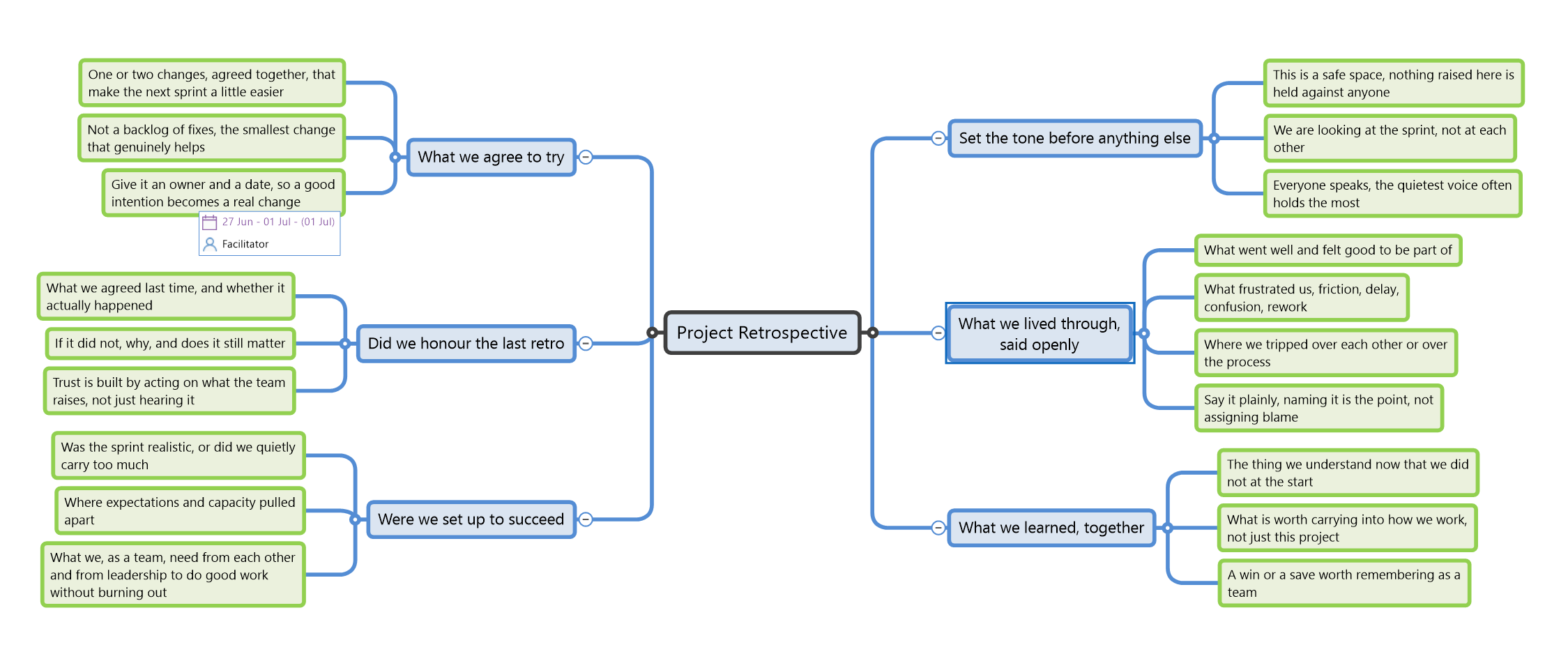
A retrospective is how a group of individuals becomes a team.
Not a backlog to tick off, but a chance to learn together, to be honest about what made the work harder, and to trust that what is raised will be acted on. The actions are a by-product of that, not the point of it.
What an honest retrospective actually does
Glad, Sad and Mad get a team talking, but they treat the retro as a checklist. This template treats it as the thing that turns a group of individuals into a team. The reflection is the work and stays as open discussion. Only the change you agree to try becomes a tracked task, because it is a by-product of an honest conversation, not the reason for having one.
Set the tone before anything else
- This is a safe space, nothing raised here is held against anyone
- We are looking at the sprint, not at each other
- Everyone speaks, the quietest voice often holds the most
What we lived through, said openly
- What went well and felt good to be part of
- What frustrated us, friction, delay, confusion, rework
- Where we tripped over each other or over the process
- Say it plainly, naming it is the point, not assigning blame
What we learned, together
- The thing we understand now that we did not at the start
- What is worth carrying into how we work, not just this project
- A win or a save worth remembering as a team
Were we set up to succeed
- Was the sprint realistic, or did we quietly carry too much
- Where expectations and capacity pulled apart
- What we need from each other and from leadership to do good work without burning out
Did we honour the last retro
- What we agreed last time, and whether it actually happened
- If it did not, why, and does it still matter
- Trust is built by acting on what the team raises, not just hearing it
What we agree to try
- One or two changes, agreed together, that make the next sprint a little easier
- Not a backlog of fixes, the smallest change that genuinely helps
- Give it an owner and a date, so a good intention becomes a real changeFacilitator