
Social Media Strategy
Most social work is reactive. React to the feed, react to what a competitor posted, react to whatever the algorithm rewarded last week. A posting schedule full of activity feels like a strategy, but it answers the question of when, never the question of why. The strategy is the part that comes before the schedule: the one thing you have decided to be known for, so that every post is a deposit into a position you chose rather than a guess made under deadline.
If you cannot say what you want to be known for, you do not have a strategy. You have a posting schedule.
Desktop downloads a file you open in MindGenius. Online opens the framework so you can look at it first, then add it to your portfolio.
No MindGenius yet? Download Desktop or start an Online trial.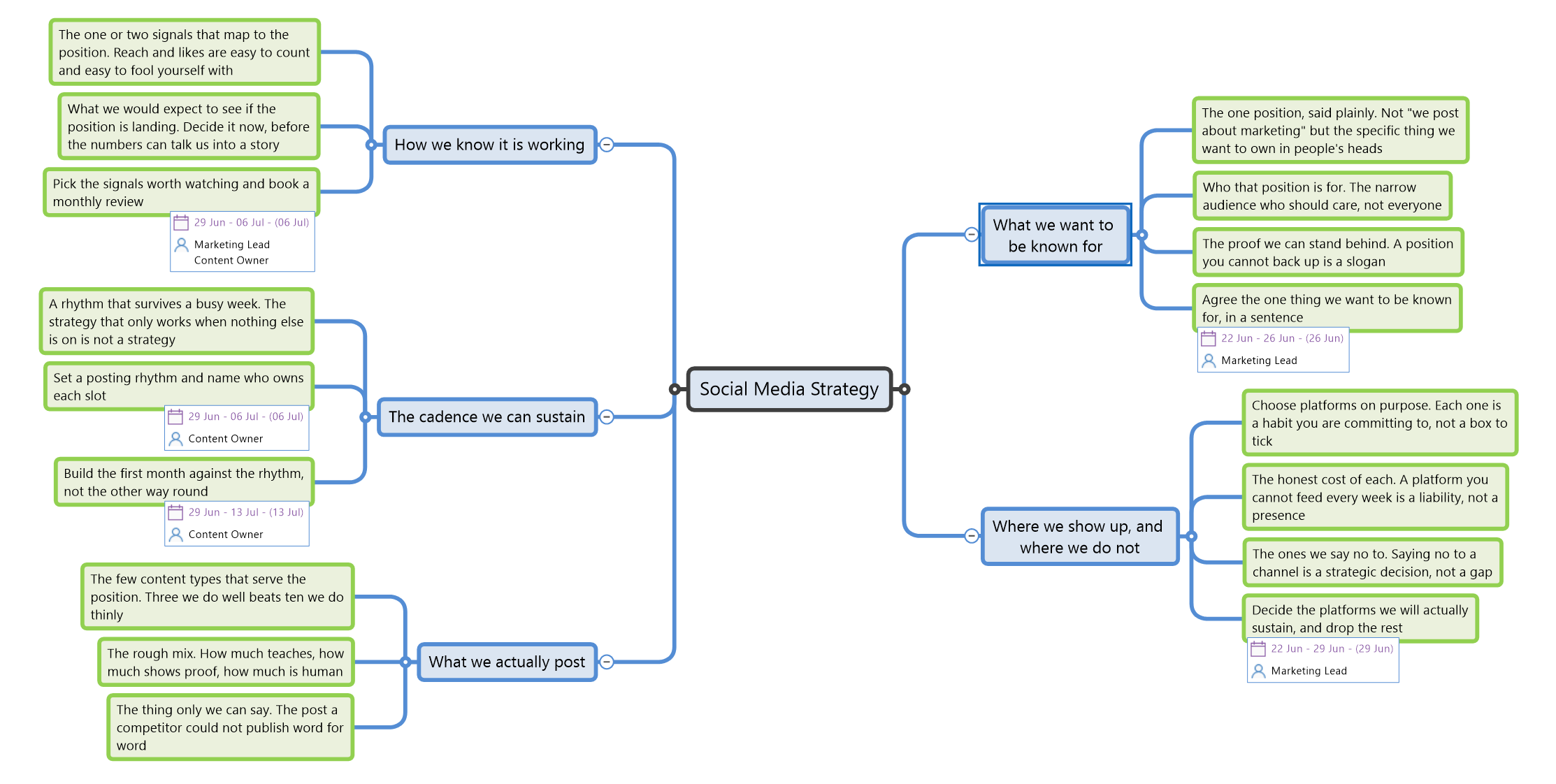
What's in the template
A worked strategy, not a blank planner. The map runs from the one thing you want to be known for to the handful of signals that tell you it is landing. Deciding what to be known for, and which platforms to say no to, carries the weight, because that is the judgement most social plans skip straight past on the way to the calendar. The thinking stays open. Only the genuine decisions become tracked tasks.
A position you cannot back up is a slogan, and a platform you cannot feed every week is a liability, not a presence. Decide the few things you will be known for, then post from them.
What we want to be known for
- The one position, said plainly. Not "we post about marketing" but the specific thing you want to own in people's heads
- Who that position is for: the narrow audience who should care, not everyone
- The proof you can stand behind, because a position you cannot back up is a slogan
- Agree the one thing you want to be known for, in a sentenceMarketing Lead
Where we show up, and where we do not
- Choose platforms on purpose. Each one is a habit you are committing to, not a box to tick
- The honest cost of each. A platform you cannot feed every week is a liability, not a presence
- The ones you say no to. Saying no to a channel is a strategic decision, not a gap
- Decide the platforms you will actually sustain, and drop the restMarketing Lead
What we actually post
- The few content types that serve the position. The test is not which categories to fill but what evidence would convince someone you genuinely own this, because three things you do well beat ten you do thinly
- The rough mix: how much teaches, how much shows proof, how much is human
- The thing only you can say. The post a competitor could not publish word for word
The cadence we can sustain
- A rhythm that survives a busy week. A strategy that only works when nothing else is on is not a strategy
- Set a posting rhythm and name who owns each slotContent Owner
- Build the first month against the rhythm, not the other way roundContent Owner
How we know it is working
- The one or two signals that map to the position. Reach and likes are easy to count and easy to fool yourself with
- What you would expect to see if the position is landing, decided now, before the numbers can talk you into a story
- Pick the signals worth watching and book a monthly reviewMarketing LeadContent Owner
The test, applied to us
It would be dishonest to teach this and not run it on ourselves. The reactive version of our own marketing would chase whatever the feed rewards this week. The position we have decided to be known for is narrower and harder to copy: structured thinking before the plan, the exploration layer that comes before the schedule. The calendar tools, the boards, the editorial grids all start after that decision is made. MindGenius is built for the part that comes first, which is the one thing we want to be known for.