
Study Course Plan
Most study plans are built for a term that never arrives: every week productive, nothing unexpected, motivation steady from October to May. Then real life happens, a heavy week, a clashing deadline, a flat few days, and the beautiful colour-coded timetable goes unopened. A plan you can only follow when nothing else is happening is not a plan, it is a wish. The useful version starts from the term you will actually have: your real free hours, the weeks already heavy, and enough slack that one bad week does not collapse the whole thing.
A study plan that only works on a good week is not a plan. Build it for the term you will actually have, not the ideal one, and it will survive contact with a real semester.
Desktop downloads a file you open in MindGenius. Online opens the framework so you can look at it first, then add it to your portfolio.
No MindGenius yet? Download Desktop or start an Online trial.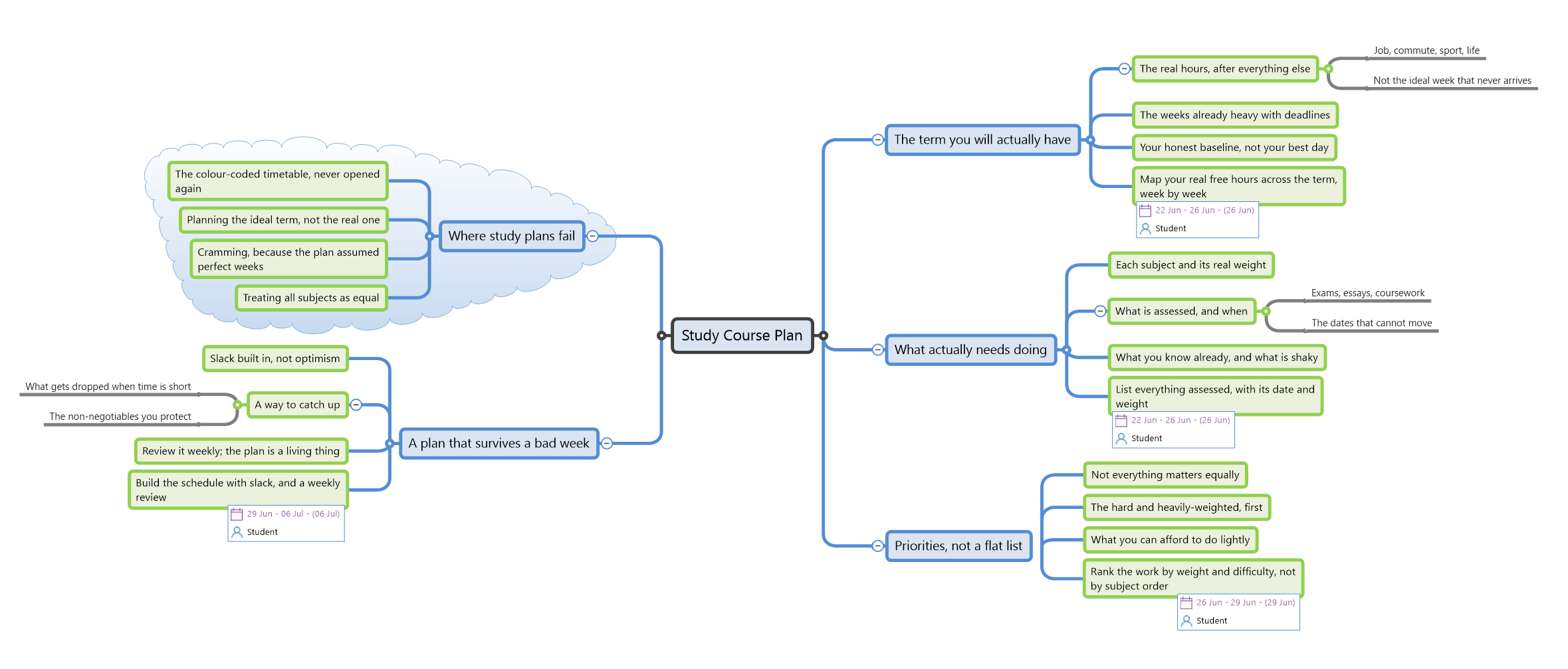
What's in the template
A worked plan that starts where most study plans skip: how much time you actually have. The capacity branch carries the weight, because a schedule built on hours that do not exist fails the first busy week. The thinking stays open. Only the genuine planning becomes tracked tasks.
Not every subject matters equally, and not every week goes to plan. Rank the work by what it is worth, and build in enough slack to absorb the week that goes wrong.
The term you will actually have
- The real hours left after everything else: the job, the commute, sport, a life. Plan against those, not the ideal week that never arrives
- The weeks already heavy with deadlines, so the crunch points are visible before they hit
- Your honest baseline, planned around a normal day, not your best one
- Map your real free hours across the term, week by weekStudent
What actually needs doing
- Each subject and the real weight it carries toward the final result
- What is assessed and when: exams, essays and coursework, and the dates that cannot move
- What you already know solidly, and what is still shaky and needs the time
- List everything assessed, with its date and weightStudent
Priorities, not a flat list
- Not everything matters equally. A flat timetable that treats every subject the same wastes time on the easy and the trivial
- The hard and heavily-weighted work first, while you still have the energy for it
- What you can afford to do lightly, named honestly rather than pretended away
- Rank the work by weight and difficulty, not by subject orderStudent
A plan that survives a bad week
- Slack built in, not optimism. The plan with no give is the plan that breaks the first time life intervenes
- A way to catch up: what gets dropped when time is short, and the non-negotiables you protect no matter what
- Reviewed weekly, because a study plan is a living thing, not a poster you make once and admire
- Build the schedule with slack, and a weekly reviewStudent
Where study plans fail
- The colour-coded timetable, made once and never opened again
- Planning the ideal term instead of the real one, so the first busy week breaks it
- Cramming at the end, because the plan quietly assumed every week would be perfect
- Treating all subjects as equal, so the easy ones get the time the hard ones needed
Why this is the part that matters
A calendar app will happily hold a study timetable, and a spreadsheet will colour it in beautifully. What neither asks is the only question that decides whether the plan survives: how many hours do you actually have, and what happens to everything else when one week goes wrong. That is a capacity judgement made before the timetable exists, with the whole term in view. It is the same question a project manager asks before committing a team, scaled down to a single student and a single semester. The scheduling tools take over once that judgement is made. MindGenius is built for the thinking that comes first.